Showing posts with label Investment. Show all posts

Thursday, December 24, 2020

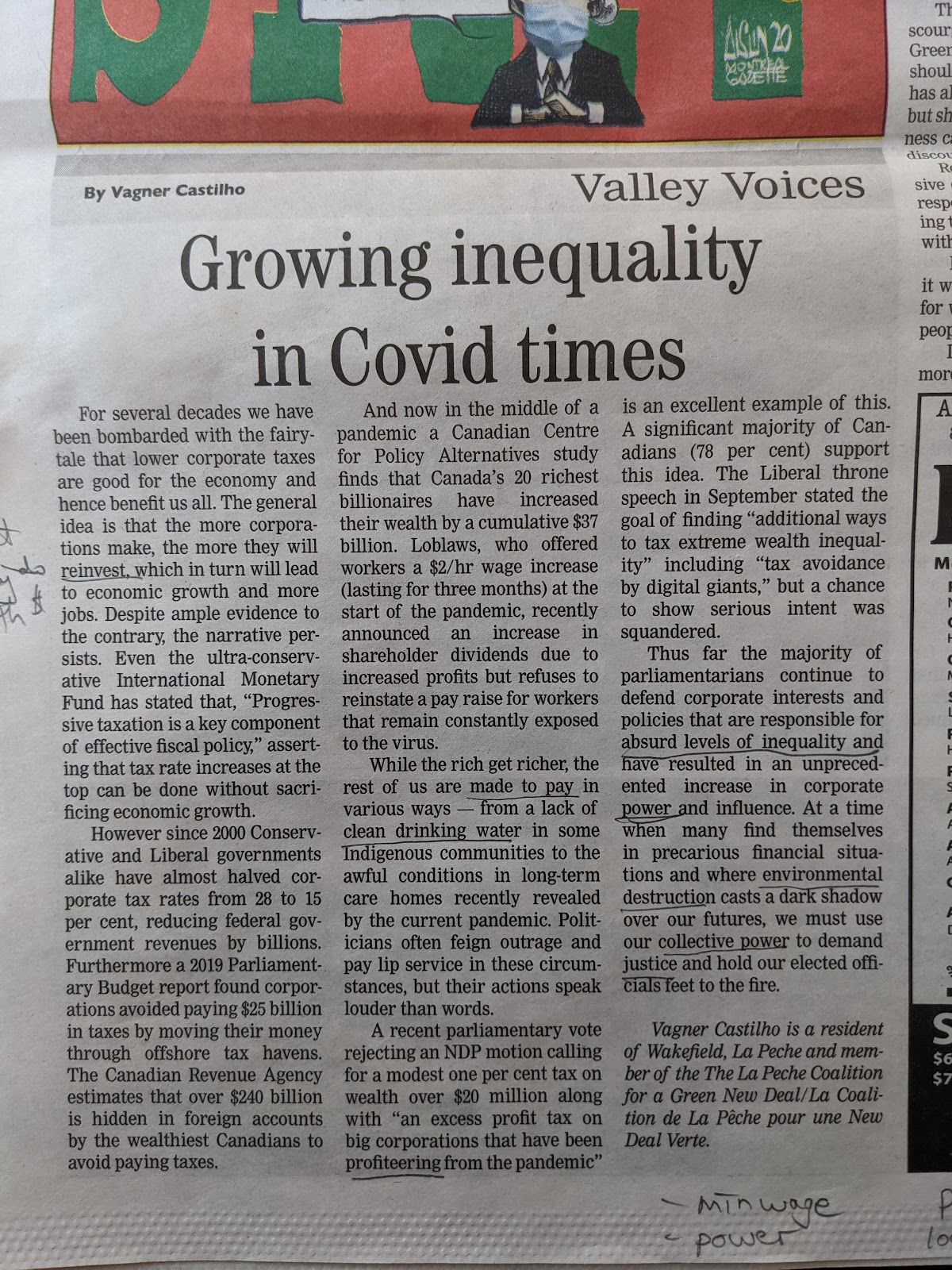
Lower business taxes are the moral and practical choice

Imagine a hockey game where every time you scored two goals one was taken from you (like a 50% tax rate) and given to your opponent! How hard would you work in that game? The Valley Voices column of December 9 is replete with ethical and economic errors, so for the moment I will use just one and let the reader consider that if the starting point is bad the rest of the column likely follows suit. The writer’s opening sentence labels the idea that lowering corporate taxes is a good thing as a fairy tale, so let’s evaluate this statement to see if the writer’s standard of value is human flourishing.

Why do you create a business? In order to live: to bring an idea that creates human values into reality to support and improve your life. You might have an idea that many people will value your ideas about food, housing, transportation, communication, health or entertainment, for example, so you set about creating a business to manifest your ideas. You set up a supply chain, production, marketing, sales, distribution and service - often these are just you in every role at first. You must set a price higher than your cost inputs so that you are creating net value, otherwise your business dies and no one’s life is supported. If you have enough customers who find your product is worth more to them than the money they pay you (price) then your business survives. The level of your profit is a pure function of how much value you are creating, as decided by the agreements between you and your customers. All such trade is win-win by its very definition, the most moral form of trade.

If you are able to create enough value to thrive, gradually you may hire others to divide the work and enable specialization and division of labour. You offer to pay your job candidates what you consider to be enough to attract the skilled people you want to hire. If they agree with your offer and are hired you are each making a profitable trade. Your pursuit of life goals creates job opportunities for others to bring their value creation ideas into reality to support their life goals. 

I can see five things you can do with each dollar of profit earned by your business. First, you may opt to build a cash reserve to protect your business during the inevitable hard times. This cash is on deposit at a bank, where it is immediately put to work through lending to meet the life goals of others. Second, you may pay down business debt to lower the risk to your business and again the bank will immediately lend this out to others. Third, you may invest in growing your business, thus creating even more win-win trade. Fourth, you may invest in other value-creating businesses by acquiring all or part of them. Finally, you may pay a dividend to the business owner(s) and the owner (maybe just you) will then either save it, pay down debt, make other investments or spend it through trade with other value-creators. All these choices are both moral and productive.

Corporate tax is the forcible taking of value from you as the business owner (what is seen), your employees (less money available for payroll - unseen pay and hiring that never happens), your suppliers (unseen purchases that never happen) and your customers (higher prices than otherwise). Such takings necessarily discourage all business activity, investment, hiring and growth; punishing the life-supporting creation of human values through production and trade. If this were not true then ever-higher taxes would create rising prosperity, punishing success would lead to even greater success and the type of hockey game described above would be popular.

In a free society when you build great wealth it can only be through great value creation. Some businesses that have grown during the current pandemic have been rewarded for creating great value during a difficult time. They have provided the goods and services most wanted by us just when we want them and at a price we are eager to pay. How much worse would this time be for millions of us without the incredibly fast and affordable supply chain created by Amazon? Many businesses and lives have been damaged and destroyed by the irrational dictates of our central planners, dictates that prevent us from thinking for ourselves and supporting our own lives by creating human values. Other businesses have of course benefitted from these dictates, but they are not to be condemned - the dictators are responsible.

The lower the business tax rate the more human reasoning, value creation and productive achievement can be achieved. To the small degree any type of taxation is needed it is better placed on the consumption of values than on their creation. To maximize human flourishing the most moral and practical business tax rate is zero percent.
Wednesday, January 10, 2018

Corporations, Inequality and Amazon

I wrote this as a comment on an Ontario Liberal Party discussion platform leading to the 2018 Ontario election. I don't know how long the link will survive, so I am pasting the text of the posted idea and earlier comments below my text.

My long comment, responding to Jenny and to the main idea:
It is a mistake to think corporate tax is not paid by individuals - only individuals pay tax. Sometimes they pay directly and sometimes through their legal entities such as corporations, partnerships and trusts. The government taxes corporations as a way to hide the tax from immediate view by citizens and is totally counterproductive. All the assets and all the profits of a corporation are engaged 100% of the time in creating value for citizens and when you tax something you get less of it.  By taxing business production you get less production and society has a lower standard of living.

The fact that 10% of Canadian already pay 55% of the taxes is not irrelevant to this issue. In many and likely most cases, the most productive people are shareholders of a corporation and thus pay both personal and corporate income taxes already.

The idea's assertion that income inequality is bad and that corporations are totally about greed is a travesty. To better understand this, consider how you become one of the rich people in society. Let's say you come up with an idea to make life better for others - to keep things super simple, say you invent a better vegetable peeler. You must invest your brain power in creating the initial idea, building prototypes, testing them, researching manufacturing and distribution. You must make sure you are not running afoul of the thousands of regulations the province has that restrict trade. You must search for and hire staff to help you get things rolling. You must learn how to deal with the intricacies of trade barriers between countries and also their internal trade barriers such as those between provinces. You must finance the equipment, marketing and inventory of the business and pay staff while the product is being brought to market; you take significant financial risks and might lose it all. 

Now assume you start to have sales, but it may take many months or even years to recover what you have invested, with no guarantees at all that you will do so. All along the way your staff have been paid and have been happy to work for that level of pay, or else they would rationally work elsewhere. No one forced them to work for you and they took no risks except those inherent in working for a small business. Every day in the early life of the company the staff worked, they were making a profit for themselves while the business founder was not. They decided they were better off, that their lives were being improved, that they received more value through their pay than the time they dedicated to the work.

Now let's say the business starts to become profitable. How? Only because enough customers have decided that their lives will be better off for buying your veggie peeler than by holding onto the few dollars it costs them. Their lives are improved in a small measure, and the business owner and all employees are also better off. Trade is a win-win transaction when it is freely chosen - it must be, by definition. If only a modest number of people agree that their lives are improved by buying your peeler.

Now to the meat: how do you become rich? A really large number of people must agree that their lives are improved by trading their dollars for your peeler. Millions of people must agree that you are creating value for them. Not only that, you are competing against all other peelers made by all other companies, plus once your peeler hits the market it will give other people ideas about how to compete with you. To build a successful business you must not only achieve excellence, you must maintain it indefinitely or else another will earn the market share you once had.

Consider Jeff Bezos, founder of Amazon, apparently the wealthiest man in the world today. His business idea has become so loved by his customers and the company has so many millions of customers that his net worth (mostly Amazon shares that could lose 100% of their value if the company fails to maintain excellence) is over $100 billion dollars. Did his wealth come at the expense of others? Did he take their piece of the so-called "income pie"? Did he achieve this by forcing people to work for him at pay lower than they chose? No. No. NO! Amazon employees all work there because they have identified Amazon as a place they want to work and have accepted the pay offered. Many employees have likely become millionaires through ownership of shares in the business. Amazon customers are better off - why else would they shop through Amazon? Thousands of other businesses sell through the Amazon platform. Many other businesses sell services to Amazon. Jeff Bezos is fabulously wealthy because he has revolutionized a portion of the marketplace and created value for hundreds of millions of people and growing. All those people have chosen to trade a small amount of their value for that provided by Bezos and his company - and they can take away everything Amazon has and all its employees and all its share value, just by changing their minds about whether Amazon is creating value in their lives. 

The fact that income inequality rises when Jeff Bezos creates incredible value for millions of people all over the world is an outcome to be celebrated, lauded and recognized as a great moral achievement, not just an economic one.  Morality is our guidelines for surviving and thriving, and the creation of a new mountain of wealth in society is the pinnacle of morality successfully applied to improve human lives. Bezos is not Bernie Madoff - he has not stolen or defrauded anyone - that is the mindset of those who see wealth as a pie to be divided. Bezos has designed, tested, baked and continues to bake new and undreamed of pies that are beloved by hordes of his fellow men. To frame it another way, Bezos' wealth has been voted to him and bestowed upon him through consumer choices as recognition by his fellow men of the value he creates.

Yes, Bezos disrupts the economy, but to improve it, not to denigrate it.

Yes, this is a right and left issue. On the right stand people who wish to be free to choose their own path in life, to be free of coercion by others or their government. On the left stand those who are against individual rights, against human freedom, against reason and the human mind, against win-win trade and for the use of force to make others do their bidding. On the left stand people with guns pointed at citizens. On the right stand people who defend the right of citizens to choose. Which side acts as a bully?

My first, short comment:
This idea is so full of errors and contradictions entire books would be needed to fully address it. A basic course in economics and finance would be a start.

Who creates, operates, finances and owns the businesses, the corporations excoriated above? Who pays the corporate taxes? Who pays individual taxes? Who earns the profits of businesses and uses them to invest in greater future production or to improve their lives? Canadians, Ontarians, taxpayers - they are synonymous. With the most productive 10% among us already paying 55% of income taxes, is that enough? Not for everyone, apparently.

Comment from Jenny:
Hi, David, the 10% paying 55% of income taxes is irrelevant. The idea was the low corporate tax; it is not that the head of the corporate is paying low personal income tax.

Wednesday, September 6, 2017

A Fossil Fuel Free Global Equity Fund? It's not right. It's not real.

In Canada, RBC funds has launched a mutual fund that uses an exclusion process to avoid companies involved in extracting, processing and transportation of fossil fuels.

They state this investment process leads to high conviction research driven portfolios and returns defined by stock-picking, not style, with a low correlation to peers.

I replied to the company's communication with the following message:

I think the concept behind the fund is incorrect, irrational, incoherent and immoral. The energy from fossil fuels has: 
a) powered the industrial revolution, 
b) advanced knowledge and society more in two hundred years than in all prior history, 
c) lifted billions of people from poverty, 
d) enabled the potential for a safe, healthy, long and productive life for all of humanity, 
e) eradicated almost all human deaths from the naturally dangerous climate, 
f) enabled us to wipe out the worst diseases of the past,
g) empowered women, minorities, former slaves and anyone with the mind and determination to do so to succeed beyond the wildest dreams of pre-industrial society,
h) much more.

To in any way promote the concept that fossil fuels, which presently provide 85% of all the power required to operate modern society, represent a meaningful threat to civilization instead of being the salvation of civilization is a monstrous distortion of reality and a disservice to all humanity. 

As a starting reference point, I have attached a fascinating article that studies the interaction between climate, human deaths and energy availability.

I note that every single holding in the fund relies utterly on fossil fuel energy to remain in existence. If fossil fuels were banned tomorrow, these companies would be instantly bankrupt and it would be the end of human civilization as we know it. With centuries of abundant, cheap, dense and portable fossil fuel energy available to us, not only is fossil fuel energy the fastest growing energy source in the world, but it is likely to remain by far the most important energy source for the next hundred years.

The company should be ashamed to be associated with the promotion of such a patently absurd concept as a fossil fuel free fund – it does not exist and should not exist.

Tuesday, September 4, 2012

Invasion of the locavestors

Terence Corcoran wrote a good editorial in the September issue of the Financial Post Magazine.  He referred to recent public discussion of corporate transactions such as Rona, Cogeco and Maple Group.  I wrote this letter to him.
Your September 2012 editorial was on target. When government interferes with a corporate sale, the rights of everyone are violated. In a free market, transactions only take place with the mutually beneficial agreement of both the buyer and seller. Unless the price is high enough for you as a seller to judge you are getting full value, you do not sell. Unless it is low enough for you as a buyer to judge you are getting a bargain you do not buy. When governments protect individual rights neither buyers nor sellers are unhappy with their transactions. By forbidding the sale/purchase of certain shares the state is forcing some people to own them and forcing others not to own them. The rights of both sellers and buyers are violated by such initiation of force.
If you sell your shares, you will then have cash available to invest in other businesses, whether new or existing. No one can tell how many businesses have been prevented from existing or growing because of the use of force against shareholders. The right of all citizens to participate in a free market and benefit from its existence is violated.

Who is to decide which individual shareholder rights will be violated by blocking a sale? What objective principle decides which companies are strategic and overrides the opinions of others. Who decides what is of national interest when a nation is made up of individuals each having their own goals? The people best suited and the only people morally correct to decide these questions are the ones who have put their decision-making ability on the line and risked their own capital by investing in the company, the people who own or wish to own the shares. Who can say you will not make more money elsewhere and bring better "strategic value" to Canada by selling instead of holding, although the question itself shows the absence of a proper morality based on individual rights. 

 Even if someone else is proven correct with time, it is your life, your money and your right to choose how you use it. Those who would stop you are anti-rights, anti-freedom and anti-life.