Showing posts with label business. Show all posts

Thursday, December 24, 2020

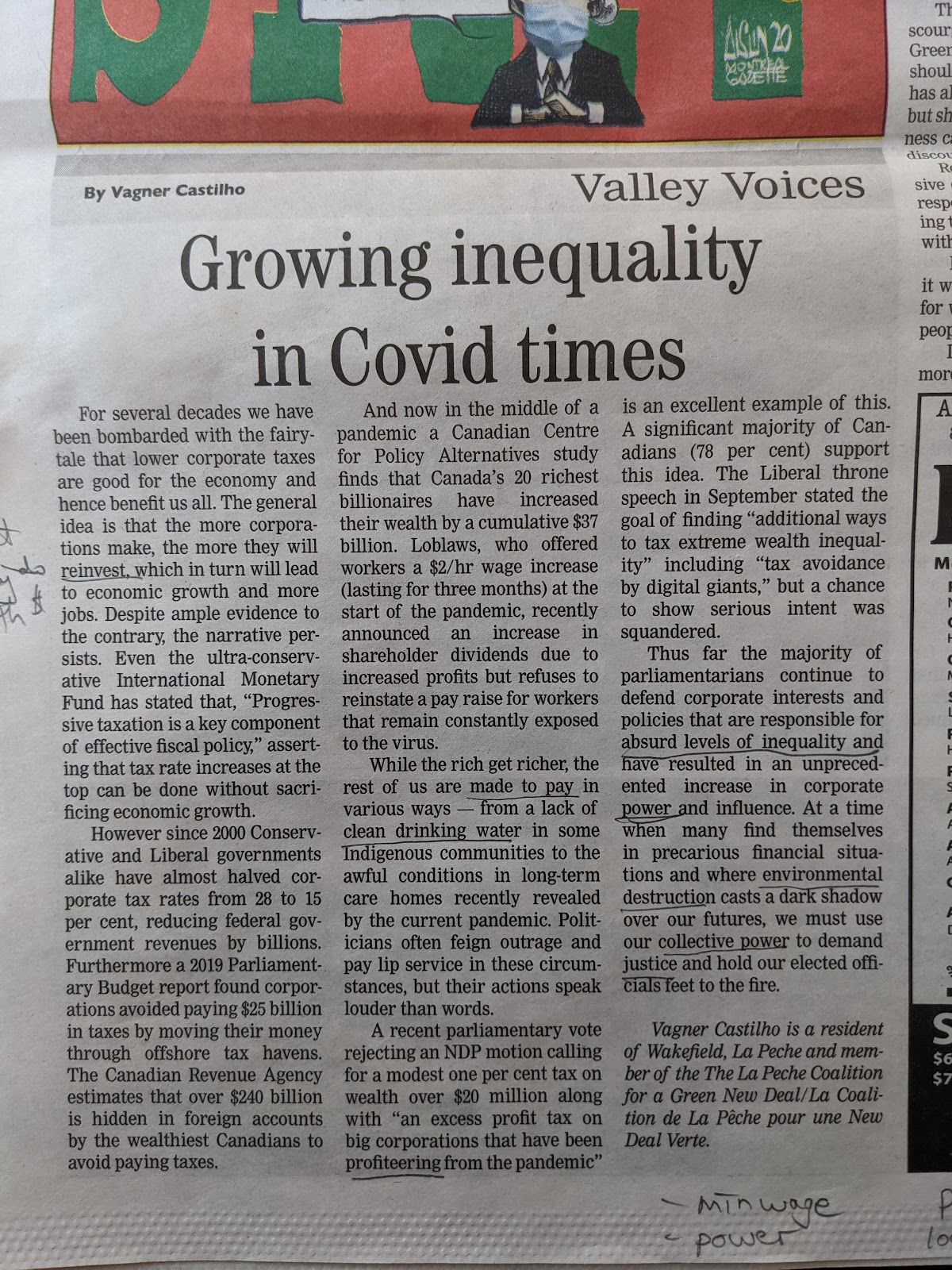
Lower business taxes are the moral and practical choice

Imagine a hockey game where every time you scored two goals one was taken from you (like a 50% tax rate) and given to your opponent! How hard would you work in that game? The Valley Voices column of December 9 is replete with ethical and economic errors, so for the moment I will use just one and let the reader consider that if the starting point is bad the rest of the column likely follows suit. The writer’s opening sentence labels the idea that lowering corporate taxes is a good thing as a fairy tale, so let’s evaluate this statement to see if the writer’s standard of value is human flourishing.

Why do you create a business? In order to live: to bring an idea that creates human values into reality to support and improve your life. You might have an idea that many people will value your ideas about food, housing, transportation, communication, health or entertainment, for example, so you set about creating a business to manifest your ideas. You set up a supply chain, production, marketing, sales, distribution and service - often these are just you in every role at first. You must set a price higher than your cost inputs so that you are creating net value, otherwise your business dies and no one’s life is supported. If you have enough customers who find your product is worth more to them than the money they pay you (price) then your business survives. The level of your profit is a pure function of how much value you are creating, as decided by the agreements between you and your customers. All such trade is win-win by its very definition, the most moral form of trade.

If you are able to create enough value to thrive, gradually you may hire others to divide the work and enable specialization and division of labour. You offer to pay your job candidates what you consider to be enough to attract the skilled people you want to hire. If they agree with your offer and are hired you are each making a profitable trade. Your pursuit of life goals creates job opportunities for others to bring their value creation ideas into reality to support their life goals. 

I can see five things you can do with each dollar of profit earned by your business. First, you may opt to build a cash reserve to protect your business during the inevitable hard times. This cash is on deposit at a bank, where it is immediately put to work through lending to meet the life goals of others. Second, you may pay down business debt to lower the risk to your business and again the bank will immediately lend this out to others. Third, you may invest in growing your business, thus creating even more win-win trade. Fourth, you may invest in other value-creating businesses by acquiring all or part of them. Finally, you may pay a dividend to the business owner(s) and the owner (maybe just you) will then either save it, pay down debt, make other investments or spend it through trade with other value-creators. All these choices are both moral and productive.

Corporate tax is the forcible taking of value from you as the business owner (what is seen), your employees (less money available for payroll - unseen pay and hiring that never happens), your suppliers (unseen purchases that never happen) and your customers (higher prices than otherwise). Such takings necessarily discourage all business activity, investment, hiring and growth; punishing the life-supporting creation of human values through production and trade. If this were not true then ever-higher taxes would create rising prosperity, punishing success would lead to even greater success and the type of hockey game described above would be popular.

In a free society when you build great wealth it can only be through great value creation. Some businesses that have grown during the current pandemic have been rewarded for creating great value during a difficult time. They have provided the goods and services most wanted by us just when we want them and at a price we are eager to pay. How much worse would this time be for millions of us without the incredibly fast and affordable supply chain created by Amazon? Many businesses and lives have been damaged and destroyed by the irrational dictates of our central planners, dictates that prevent us from thinking for ourselves and supporting our own lives by creating human values. Other businesses have of course benefitted from these dictates, but they are not to be condemned - the dictators are responsible.

The lower the business tax rate the more human reasoning, value creation and productive achievement can be achieved. To the small degree any type of taxation is needed it is better placed on the consumption of values than on their creation. To maximize human flourishing the most moral and practical business tax rate is zero percent.
Friday, April 13, 2018

James Hansen advocates fighting climate change by suing everyone in sight, including ourselves


As thousands of government representatives prepared to jet to Germany for the COP23 climate conference in the fall of 2017, the volume and stridence of proclamations from the leaders of the climate change alarmist movement rose quickly.

Former NASA scientist James Hansen was quoted several times in a Nov. 7, 2017 National Geographic interview, in which he recommended suing the world’s biggest oil, coal and gas, and cement companies for damages resulting from climate change. He says 100 companies have been the source of more than 70 percent of the world’s greenhouse gas emissions since 1988. The article tells us “An enormous amount of money is urgently needed to dramatically slash emissions of carbon dioxide (CO2), take existing CO2 out of the atmosphere, and for countries to cope with the impacts of climate change, Hansen argues. And that money should come from the companies that profited most from burning fossil fuels, Hansen will tell world leaders Tuesday in Bonn, Germany, at the annual United Nations climate negotiations.”

Later, the article says “Hansen is involved in a 2015 lawsuit against the U.S. federal government, brought by 21 kids under the age of 21, including his own granddaughter. The case argues that the government’s failure to curb CO2 emissions has violated the youngest generation’s constitutional rights to life, liberty, and property.”

If Hansen’s assertions are correct and all our lives are damaged by greenhouse gas emissions, then suing those who harm us might be one way to reduce the harm. But are his assertions true? How do we know? One good way to examine the validity of a statement is to follow it to its logical end and see if it makes sense. Let’s examine two aspects of Hansen’s assertions: that we have all been harmed by CO2 emissions and that suing big companies is a solution.

According to Hansen, all our lives should be much worse off because of greenhouse gas emissions and their supposed causal effect of increasing global temperature. We should have powerful measurable evidence of harm to humanity. Reality contradicts Hansen since by all objective measures our lives have become safer, longer, healthier and richer as humanity has created more energy from fossil fuels. As Indur Goklany says in Humanity Unbound - How Fossil Fuels Saved Humanity from Nature and Nature from Humanity “From 1750 to 2009, global life expectancy more than doubled, global population increased 8-fold, and incomes increased 11-fold. How did this happen? While there were many factors tracing their roots to the renaissance and enlightenment, the rapid industrialization of the West was made possible and supercharged by the discovery and exploitation of industrial scale energy production - energy that powers all other industries. As Goklany states, even today when other energy sources like hydro, nuclear, solar and wind have been discovered and industrialized, “...fossil fuels provide 80 percent of mankind’s energy and 60 percent of its food and clothing.” Clearly, civilization depends on fossil fuel energy and is likely to do so for quite some time.

But has our environment become more dangerous as we exploit this energy? Not at all, points out Goklany, in fact “Global death rates from extreme weather events declined by 98 percent since the 1920s, while economic damages corrected for population growth and wealth have not increased.”

What about Hansen’s assertion we should sue the very companies that have provided the energy and structure that powers the modern world? What would it mean to sue them? Who owns these companies? Well, in brief - we all do. The shares of these publicly traded companies are owned in our individual investment accounts, our group investment plans, our pension plans and the pension plans of our governments. Perhaps hundreds of millions of people own a part of companies like Exxon.

Following the lawsuit process to the end would mean suing ourselves and our neighbors and friends, our employers and our governments, even our children and our parents. Hansen would be suing his granddaughter and she him at the same time they would both be suing the companies that built and power their schools, hospital, roads, homes, and cell phones. They would be suing the creators of the internet and the content that rides on it like that produced by Disney, the artists who travel between cities for productions like Disney on ice, the builders of the ice rinks and power companies who enable the existence of ice rinks in the desert. Hansen would be suing all of human civilization and almost everyone alive today except the few primitives who remain isolated from modern society. In short, it would mean everyone attacking everyone at the same time. To borrow a term from the current movie scene, it would be Ragnarok! Hansen’s call to sue the top 100 producers of CO2 emissions is nothing less than a call for the end of civilization and the virtual elimination of humanity, his granddaughter included.

One of the many things Hansen does not understand is that companies are not people, they are owned by people - many people. The companies have not been the ones profiting from industrial scale energy production, people are. Not just those who own the company, but all those who are customers of the company or customers of their customers. It is the daily choices of all the people in the economic chain of activity that have directed money and profits towards those big companies, and it can be taken away at any time if consumer preferences shift. This is a much more powerful (and what’s more it is a fully moral) method of tuning and improving the marketplace for energy. Whereas the free market price mechanism provides an elegant and infinitely adaptable solution to potential economic challenges like the effects of climate change, Hansen would use a club and rock to smash our biggest and best energy producers to impose his radical personal views on the rest of us. I hope his granddaughter does not grow up to ever see the world in the state that Hansen’s ideas would take us.

Wednesday, January 10, 2018

Corporations, Inequality and Amazon

I wrote this as a comment on an Ontario Liberal Party discussion platform leading to the 2018 Ontario election. I don't know how long the link will survive, so I am pasting the text of the posted idea and earlier comments below my text.

My long comment, responding to Jenny and to the main idea:
It is a mistake to think corporate tax is not paid by individuals - only individuals pay tax. Sometimes they pay directly and sometimes through their legal entities such as corporations, partnerships and trusts. The government taxes corporations as a way to hide the tax from immediate view by citizens and is totally counterproductive. All the assets and all the profits of a corporation are engaged 100% of the time in creating value for citizens and when you tax something you get less of it.  By taxing business production you get less production and society has a lower standard of living.

The fact that 10% of Canadian already pay 55% of the taxes is not irrelevant to this issue. In many and likely most cases, the most productive people are shareholders of a corporation and thus pay both personal and corporate income taxes already.

The idea's assertion that income inequality is bad and that corporations are totally about greed is a travesty. To better understand this, consider how you become one of the rich people in society. Let's say you come up with an idea to make life better for others - to keep things super simple, say you invent a better vegetable peeler. You must invest your brain power in creating the initial idea, building prototypes, testing them, researching manufacturing and distribution. You must make sure you are not running afoul of the thousands of regulations the province has that restrict trade. You must search for and hire staff to help you get things rolling. You must learn how to deal with the intricacies of trade barriers between countries and also their internal trade barriers such as those between provinces. You must finance the equipment, marketing and inventory of the business and pay staff while the product is being brought to market; you take significant financial risks and might lose it all. 

Now assume you start to have sales, but it may take many months or even years to recover what you have invested, with no guarantees at all that you will do so. All along the way your staff have been paid and have been happy to work for that level of pay, or else they would rationally work elsewhere. No one forced them to work for you and they took no risks except those inherent in working for a small business. Every day in the early life of the company the staff worked, they were making a profit for themselves while the business founder was not. They decided they were better off, that their lives were being improved, that they received more value through their pay than the time they dedicated to the work.

Now let's say the business starts to become profitable. How? Only because enough customers have decided that their lives will be better off for buying your veggie peeler than by holding onto the few dollars it costs them. Their lives are improved in a small measure, and the business owner and all employees are also better off. Trade is a win-win transaction when it is freely chosen - it must be, by definition. If only a modest number of people agree that their lives are improved by buying your peeler.

Now to the meat: how do you become rich? A really large number of people must agree that their lives are improved by trading their dollars for your peeler. Millions of people must agree that you are creating value for them. Not only that, you are competing against all other peelers made by all other companies, plus once your peeler hits the market it will give other people ideas about how to compete with you. To build a successful business you must not only achieve excellence, you must maintain it indefinitely or else another will earn the market share you once had.

Consider Jeff Bezos, founder of Amazon, apparently the wealthiest man in the world today. His business idea has become so loved by his customers and the company has so many millions of customers that his net worth (mostly Amazon shares that could lose 100% of their value if the company fails to maintain excellence) is over $100 billion dollars. Did his wealth come at the expense of others? Did he take their piece of the so-called "income pie"? Did he achieve this by forcing people to work for him at pay lower than they chose? No. No. NO! Amazon employees all work there because they have identified Amazon as a place they want to work and have accepted the pay offered. Many employees have likely become millionaires through ownership of shares in the business. Amazon customers are better off - why else would they shop through Amazon? Thousands of other businesses sell through the Amazon platform. Many other businesses sell services to Amazon. Jeff Bezos is fabulously wealthy because he has revolutionized a portion of the marketplace and created value for hundreds of millions of people and growing. All those people have chosen to trade a small amount of their value for that provided by Bezos and his company - and they can take away everything Amazon has and all its employees and all its share value, just by changing their minds about whether Amazon is creating value in their lives. 

The fact that income inequality rises when Jeff Bezos creates incredible value for millions of people all over the world is an outcome to be celebrated, lauded and recognized as a great moral achievement, not just an economic one.  Morality is our guidelines for surviving and thriving, and the creation of a new mountain of wealth in society is the pinnacle of morality successfully applied to improve human lives. Bezos is not Bernie Madoff - he has not stolen or defrauded anyone - that is the mindset of those who see wealth as a pie to be divided. Bezos has designed, tested, baked and continues to bake new and undreamed of pies that are beloved by hordes of his fellow men. To frame it another way, Bezos' wealth has been voted to him and bestowed upon him through consumer choices as recognition by his fellow men of the value he creates.

Yes, Bezos disrupts the economy, but to improve it, not to denigrate it.

Yes, this is a right and left issue. On the right stand people who wish to be free to choose their own path in life, to be free of coercion by others or their government. On the left stand those who are against individual rights, against human freedom, against reason and the human mind, against win-win trade and for the use of force to make others do their bidding. On the left stand people with guns pointed at citizens. On the right stand people who defend the right of citizens to choose. Which side acts as a bully?

My first, short comment:
This idea is so full of errors and contradictions entire books would be needed to fully address it. A basic course in economics and finance would be a start.

Who creates, operates, finances and owns the businesses, the corporations excoriated above? Who pays the corporate taxes? Who pays individual taxes? Who earns the profits of businesses and uses them to invest in greater future production or to improve their lives? Canadians, Ontarians, taxpayers - they are synonymous. With the most productive 10% among us already paying 55% of income taxes, is that enough? Not for everyone, apparently.

Comment from Jenny:
Hi, David, the 10% paying 55% of income taxes is irrelevant. The idea was the low corporate tax; it is not that the head of the corporate is paying low personal income tax.

Wednesday, July 10, 2013

Ottawa vs Eugene Melnyk in the Ottawa casino controversy

I created a four minute video to explain what is wrong with government controlling business decisions, using the proposed Ottawa casino as an example.


Friday, May 31, 2013

The right of a business to exist and follow its own path

Take a look at http://www.universitybusiness.com/article/divestment-debate

The scariest part of this article is not the validation of organizations bent on controlling larger parts of society through eco-scare tactics, but the philosophical base on which their ideas rest, as exemplified by the statement "their social license to continue business as usual" by President Stephen Mulkey of Unity College, Vermont.

Businesses are nothing more than individuals who have organized their productive activities into a particular structure.  In the case of the ones referred to by Mulkey, they are businesses successful enough, that provide enough added value to their fellow human beings that they are able to list their shares on a stock exchange. Most businesses never achieve that level of distinguished value creation and remain privately held throughout their existence.

Businesses, whether small or large, private or public, are always owned by individual human beings and so the rights of a business are nothing more or less than individual human rights being expressed in more complex ways. Morally, businesses right to exist is derived directly from the human rights to life, liberty and property. Just as individuals are morally right to pursue their own happiness and goals in life, so are businesses right, and have the right, to pursue their goals - so long as they do not initiate physical force against others.  Morally, there is no such thing as "a social license to continue business as usual" and to make such a statement is to imply that individuals right to exist depends on a social license.  This idea is the foundation of all the most monstrous regimes seen in human history, recently in Russia, China, Germany and North Korea. It is the idea that man must live for the sake of others (the morality of altruism) that must be purged if society is to survive, and it is the individual rights of the individual as identified by America's founding fathers, life, liberty and property, that must be upheld if society is to thrive.