Showing posts with label Economics. Show all posts

Monday, September 19, 2022

Climate of injustice

 A response to a letter in The Low Down, Sept 14-20, 2022 titled "Together for climate justice"

I am responding to the seemingly endless demands by the La Peche Coalition for a Green New Deal to forcefully implement policies to combat the gas of life - carbon dioxide. It is sad to read so many letters based on ignorance of science, economics and most of all a proper ethical framework.

For over 20 years I have closely followed the evolution of scientific knowledge about our climate by reading many books written by eminent scientists and subject-matter experts and keeping an eye on many of the thousands of studies connected to the Earth's climate. Long ago I could tell from a broad review of the literature that climate alarmism was based on distortions, bad statistical and scientific methodology, and most of all bad ideology. The premise that the Earth is a delicate nurturer best left untouched by man's activities is contrary to the nature of human life, which is to apply reason to the challenges of survival in a naturally dangerous and deficient environment. Humans thrive only by reshaping and improving our world. I have come across thousands of studies and many basic facts of reality that directly contradict the idea that there is any kind of climate crisis and anyone who does a broad reading of the literature would easily find the same. I encourage readers to see for themselves, perhaps starting with the recent book "Fossil Future" that provides an irrefutable case and moving on from there for those who want more technical information.

Economically, fossil fuel energy presently makes up more than 80% of the world energy supply and is always the best and preferred way for poor countries to solve their problems of starvation, disease and suffering. Three billion people have less energy than a typical refrigerator and have a massive need for more energy. Alarmists almost always ignore the massive benefits of fossil fuel energy and focus only on the manageable side-effects, like focusing only on vaccine side-effects and ignoring the benefits. Wind and solar may have a small role to play in generating electricity but due to their intermittent, dilute and unreliable nature they are spectacularly unsuited for economical grid-scale power, plus require massive mining projects mostly in third world countries and dictatorships, leading to horrible pollution problems. A call to end fossil fuel energy is a call for the continuation of uman suffering for the billions of people who do not yet enjoy our level of energy capability and te mass murder of those who would lose the life-giving energy from fossil fuels we now enjoy. 

Politically, a call for a green new deal is a call for fascism, as few populations will voluntarily choose societal suicide for very long. Witness the dramatic policy reversal in the UK when it became clear that mass suffering would quickly result from the loss of reliable, cheap energy. If all state coercion and subsidies was removed from the energy market and humans were free to produce and trade, I know there would be almost no wind and solar infrastructure built and human progress would leap forward.

Ethically, the right framework is one of respect for human rights: your right to peacefully pursue your own values and to keep the product of your work. It is unethical to lie about the state of scientific knowledge in an effort to achieve power over the lives of others, unethical to call for the destruction of a safe, cheap and reliable energy system that sustains the lives of billions of people with no viable replacement in hand, unethical to cry for the use of political force against billions of innocent people trying to live in peace. The right ethical path is one towards an objective assessment of reality, the recognition of the ability of individuals to think for themselves and to produce values to trade with others and a government whose function is to protect our rights and never violate them. We have a long way to go but a move in the right direction would be a good start. It begins with every individual thinking.

Thursday, December 24, 2020

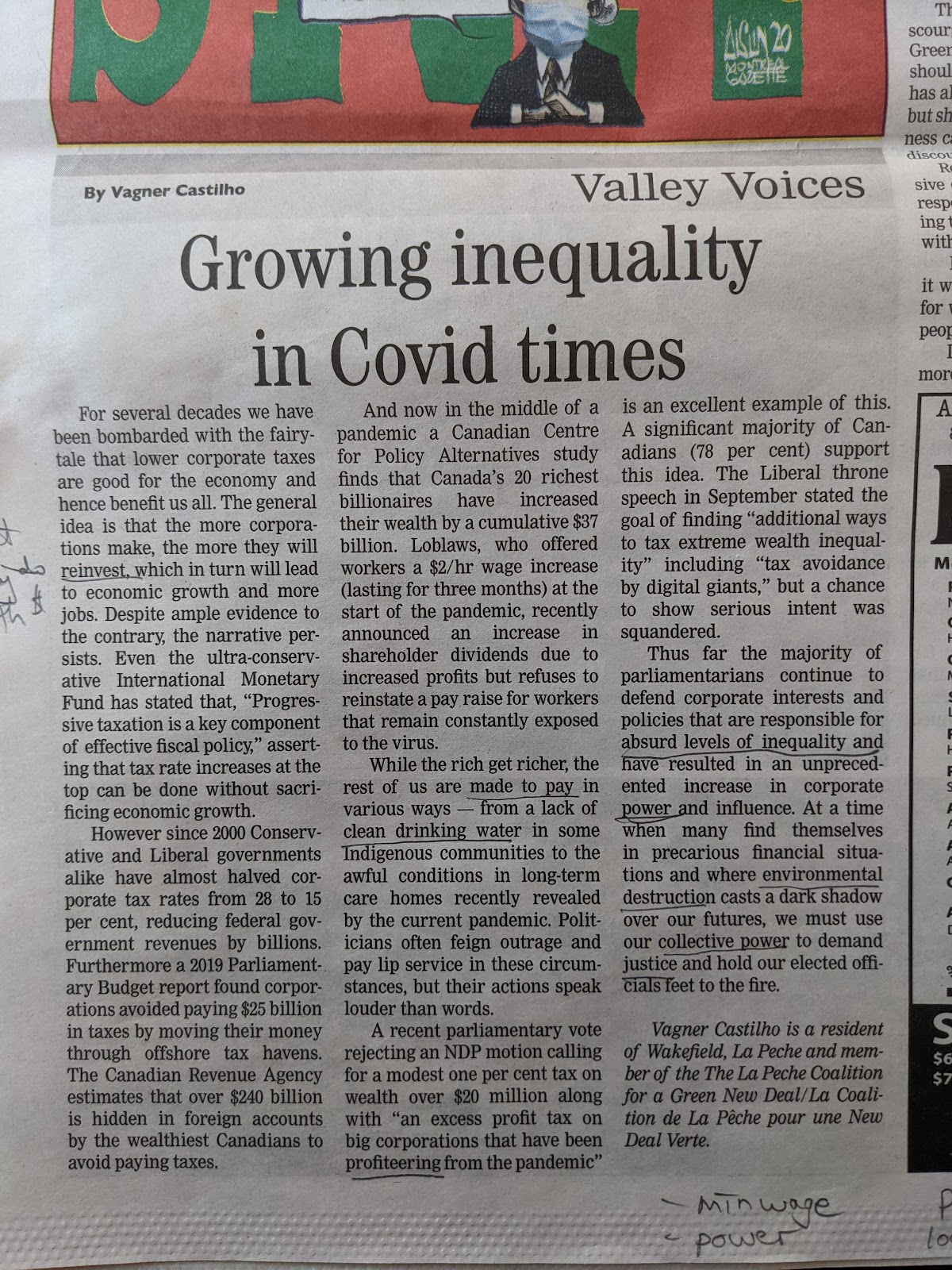
Lower business taxes are the moral and practical choice

Imagine a hockey game where every time you scored two goals one was taken from you (like a 50% tax rate) and given to your opponent! How hard would you work in that game? The Valley Voices column of December 9 is replete with ethical and economic errors, so for the moment I will use just one and let the reader consider that if the starting point is bad the rest of the column likely follows suit. The writer’s opening sentence labels the idea that lowering corporate taxes is a good thing as a fairy tale, so let’s evaluate this statement to see if the writer’s standard of value is human flourishing.

Why do you create a business? In order to live: to bring an idea that creates human values into reality to support and improve your life. You might have an idea that many people will value your ideas about food, housing, transportation, communication, health or entertainment, for example, so you set about creating a business to manifest your ideas. You set up a supply chain, production, marketing, sales, distribution and service - often these are just you in every role at first. You must set a price higher than your cost inputs so that you are creating net value, otherwise your business dies and no one’s life is supported. If you have enough customers who find your product is worth more to them than the money they pay you (price) then your business survives. The level of your profit is a pure function of how much value you are creating, as decided by the agreements between you and your customers. All such trade is win-win by its very definition, the most moral form of trade.

If you are able to create enough value to thrive, gradually you may hire others to divide the work and enable specialization and division of labour. You offer to pay your job candidates what you consider to be enough to attract the skilled people you want to hire. If they agree with your offer and are hired you are each making a profitable trade. Your pursuit of life goals creates job opportunities for others to bring their value creation ideas into reality to support their life goals. 

I can see five things you can do with each dollar of profit earned by your business. First, you may opt to build a cash reserve to protect your business during the inevitable hard times. This cash is on deposit at a bank, where it is immediately put to work through lending to meet the life goals of others. Second, you may pay down business debt to lower the risk to your business and again the bank will immediately lend this out to others. Third, you may invest in growing your business, thus creating even more win-win trade. Fourth, you may invest in other value-creating businesses by acquiring all or part of them. Finally, you may pay a dividend to the business owner(s) and the owner (maybe just you) will then either save it, pay down debt, make other investments or spend it through trade with other value-creators. All these choices are both moral and productive.

Corporate tax is the forcible taking of value from you as the business owner (what is seen), your employees (less money available for payroll - unseen pay and hiring that never happens), your suppliers (unseen purchases that never happen) and your customers (higher prices than otherwise). Such takings necessarily discourage all business activity, investment, hiring and growth; punishing the life-supporting creation of human values through production and trade. If this were not true then ever-higher taxes would create rising prosperity, punishing success would lead to even greater success and the type of hockey game described above would be popular.

In a free society when you build great wealth it can only be through great value creation. Some businesses that have grown during the current pandemic have been rewarded for creating great value during a difficult time. They have provided the goods and services most wanted by us just when we want them and at a price we are eager to pay. How much worse would this time be for millions of us without the incredibly fast and affordable supply chain created by Amazon? Many businesses and lives have been damaged and destroyed by the irrational dictates of our central planners, dictates that prevent us from thinking for ourselves and supporting our own lives by creating human values. Other businesses have of course benefitted from these dictates, but they are not to be condemned - the dictators are responsible.

The lower the business tax rate the more human reasoning, value creation and productive achievement can be achieved. To the small degree any type of taxation is needed it is better placed on the consumption of values than on their creation. To maximize human flourishing the most moral and practical business tax rate is zero percent.

Sunday, December 16, 2018

On the wonders of plastics

I'd like to offer another perspective on plastic - a constructive one - to contrast with that of Eric Schiller in the December 2018 edition of Image. If I wanted to thoroughly explain all the ways the inventors and entrepreneurs and businessmen who have brought us plastic have improved our lives I would need a collection of books to do so.

From the plastics that make up much of the computer I am typing this letter on, to the wireless router in another room, the shielding on the cable that connects my house to the world wide web, my ability to exchange ideas with the whole world would be impossible without plastics.

Plastics are widely used in medicine to make surgeries better and safer, to keep hospitals cleaner, to make sure medicines from the pharmacy are safer, and as above, to enable to vast network of knowledge and communications used in modern medicine. Our health depends on plastics.

Our food supply is greatly enhanced through the use of plastics in agricultural equipment, in the processes of harvesting, processing, shipping, and packaging of foods to keep them safe, fresh, cheap and convenient. I just had a glass of milk and a slice of toast with margarine and honey made from bread I made yesterday in my breadmaker. A substantial part of the breadmaker is plastic, my margarine and honey was safely sold to me in a plastic container, I kept my bread in a super-handy plastic ziploc bag, my glass of milk was safely and cheaply delivered in a plastic bag made with maybe a tablespoon of plastic and was kept cool and safe in a fridge made with lots of plastic.

It is easy to take for granted the hundred or thousand plastic items all around my house that improve my life every day. Plastics improve my clothes, transportation, education, climate, comfort, food, entertainment, safety and everything else these days. What a wonderful, human, life-promoting, innovative, adaptable, material! I an indebted to the great businesses that make this possible.

It is a myth that there are "vast ocean islands of plastic." Such areas naturally occur due to the mechanics of ocean circulation, but the plastic density there is more like flecks of pepper in your soup rather than an island. If there was an actual island then clever businesses could take a boat over there and collect it for large profits - and this would be good, but the fact is this is not possible.

Mr. Schiller says plastic bottles end up in the environment, as if the materials they are made from did not originate in the environment. The environment is not suffering since it is not a conscious being. In fact, my environment has been improving from the day I was born due to continuing advances in technology by entrepreneurs and industrialists. When societies rise from their primitive, collectivist, pre-industrial state to a more free, wealthier, life-promoting, more capitalist one, there are by-products of industrialization that may be identified as pollution by those in more advanced societies because we have already passed the top of the inverted-U shape normally found during development. As a society produces more wealth, pollution rises yet quality of life rises fast. Once a certain level of wealth is achieved people can afford to take greater care and pollution falls. This is a basic economic principle.

A call for the elimination of plastic bottles through political means is a move towards dictatorship. When I, a living, thinking, reasoning and relatively free human being have decided to buy water in a safe, portable and inexpensive plastic bottle, by what right does anyone else forbid me to do so? Who is to decide if the bottle is needed if not the individual buying it? You? What if I refuse to follow your command? By making this a political issue you are asking for the power of the gun (the only power politics provides) to be used against me and/or those who so helpfully produced it and sold it to me. Is this the right way for reasoning beings to live - taking away water bottles from fellow human beings at gunpoint? If you wish to deal with me as a human being, use reason, education and persuasion to show me a way that I can see is better for my life and don't threaten me with government-enforced bans.

Thursday, September 20, 2018

The Ontario government wants to hear ideas

In September 2018 the newly elected Ontario government surveyed the public regarding areas of priority for government action. Part of the questionnaire asked for up to three ideas that will improve the delivery of programs and services. The idea must:


  • not ask for funding for a specific individual, group, organization, company and/or business 
  • be within scope of the Ontario government to deliver (please check to make sure your idea is not the responsibility of a municipal government or the federal government) 
  • follow our terms of use – your idea will not be considered if it violates our terms
  • be feasible, practical and affordable for us to implement in the short term
  • be sustainable and provide long-term benefits.

Here are my ideas as submitted.

Sector: economic development.  Government is the agency of force in society and should only act when force is required. Any other action can only serve to distort, override and negate the choice citizens have already made or want to make - it cannot be otherwise. All such interventions make society poorer, less free and slow progress. All forms of subsidies, incentives, grants, programs, agencies and the like should be dismantled in an orderly fashion with a clear explanation of why they have no place in a free society and state the benefits of stopping such interference. It must be based on a clear an unambiguous moral principle so it can withstand the inevitable outrage and attacks by leftists. Such actions would eliminate a great amount of government spending while also liberating millions of Ontarians to follow their own ideas instead of those chosen by a handful of ineffective bureaucrats.

Sector: resources and environment. Aside from laws related to the protection of individual rights in the resources and environmental domain, provincial government should withdraw from all interventions, including programs, subsidies, incentives, campaigns, etc. If government will properly protect rights and stop violating them, Ontarians can use their minds to pursue their own reasoning and develop resources through win-win transactions. In the environmental arena, all that is needed is for government to protect our property rights - to not have our water, land and air polluted in a way that is demonstrably harmful to human life and to set levels that are realistic in the context of an industrial society and do not impair human progress.

Sector: Heath. Health care is so monopolized and stifled by government control and monopoly power that it creates a shortage of supply, excess demand, long waiting lists and an inflexible industry. Health is much too important for human flourishing to have it so dominated by the agency of force in society. Doctors cannot innovate in service delivery. Hospitals cannot prioritize and innovate. Patients have no idea of the true cost of anything and the vital price signals generated by a population of millions, each acting according to their own values and priorities, are destroyed and cripple the system. In health areas where there is little or no government control, progress is rapid, efficiencies are steadily improved, innovation flourishes and providers compete for the attention of customers. Look at dentists, chiropractors and other professionals that spring up in an endless supply to meet all conceivable demand.For the sake of all our futures, Ontario must begin to de-control health care and return the decision-making power to individual citizens. The current massive interference in the health care decisions of Ontarians is patently immoral, impractical, dysfunctional and has no place in a free society.

Tuesday, May 8, 2018

A tragedy of the commons

In discussion with a Facebook friend we ventured into talking about communities where restrictive covenants are used to define specific property rights. My friend posted a link to a definition of the "tragedy of the commons" and my response follows.

So.. tragedy of the commons. I know the concept. I see this as a serious problem only for societies that do not have clear property rights. When there is property that "no one owns but everyone owns", i.e. state-owned property, there is no way to allocate resources, to determine priorities, to objectively resolve disputes, to coordinate economic activities.

The reference you provided refers to demand overwhelming supply. In a free market this is impossible except in the very short term because free people can expand the supply of any given resource. To many people this is counter-intuitive because they see resources as finite, as mere physical objects, when in fact resources are everything in reality that man's mind can conceive. Every single thing we see as a resource today has existed for millions of years - the difference is that humanity did not have the reasoning ability, the knowledge and the social structures of freedom and capitalism to realize the potential of these resources. Let me provide a few examples.

Until the minds of men were able to discover and exploit the principles of chemistry, that dark, gunky, toxic soil that was a blight for farming was worse than useless but today has become the most abundant, most economical, most life-supporting energy source yet discovered - oil and other fossil fuels.

Until the minds of men discovered certain principles of chemistry and physics, there was no such thing as steel, aluminum and a multitude of alloys that today support the structure of our homes, our offices, our factories, our bridges, cars, trains and planes.

Until the minds of men discovered and exploited certain principles of biology, the perpetual state of almost all mankind was starvation and malnutrition but today our supply of food has expanded so far obesity has become a problem in many advanced nations and risks becoming so for even poorer nations in just a few decades. I think most people would rather have the challenges of obesity than starvation.

Thanks to enlightenment thinkers, industrialists in relatively free countries discovered ways to mass produce goods and services in such vast quantities that supply not only exceeded what their contemporary populations could use, but can now provide supply for a vastly increased population with little difficulty.

Supply is not a function of a limited view of resources but rather one of human imagination and freedom. If one specific physical resource appears to be in short supply, a free economy sees its price rise, which then attracts additional attention from producers, who then work to discover new ways of producing or alternatives that may even make the earlier ways entirely obsolete. The energy field is a classic example. In the early part of this century there was a hue and cry about "peak oil" and forecasts of doom. Oil prices rose rapidly. Alternatives were sought and so quickly discovered and implemented that the USA, which was previously a huge oil importer, now is an exporter. If government and anti-human activists had seen this coming they would have had a decent shot at preventing such progress and this is evidenced by their strident opposition to shale oil, horizontal drilling, hydraulic fracturing, oil pipelines, oil tankers, oil trains, and even the production of oil and other fossil fuel sources - they oppose every single economic source of energy. This advance happened so fast they were caught flat-footed. Today, the supply of oil and other fossil fuel energy is greater than at any time in human history, not because the raw material was not available, but because human minds had not yet identified it and found ways to make it a resource.

And what's next after fossil fuels? Likely fusion, which requires raw materials that are incredibly abundant and is a process that produces nothing humanity considers a pollutant. The potential supply of energy from fusion is so vast it is easily a thousand times more than that of fossil fuels, and we have centuries of supply of fossil fuels remaining. From a time less than two hundred years ago when whales were being killed for their oil to today when we can see unlimited energy resources in front of our noses, the raw materials found in nature did not change one iota. What changed was that men were largely left free to make the best use of the resources they had currently discovered and this enabled them to discover even more resources. it was not environmental activists who saved the whales but the geologists and engineers and venture capitalists who launched the age of oil that did so.

Now back to the tragedy of the commons. Imagine what would have happened if all property was owned by the state instead of by individual people and the voluntary relationship groups they form such as partnerships and corporations. Do you think we would have ever advanced to the stage of having industrial scale steel, aluminum, oil or anything else? Not a chance.These great leaps forward always occur in the more free society, where there is a degree of respect for the individual human being, where citizens have property rights and a government protects these rights, including intellectual property rights. While a country founded upon enlightenment principles leaped further forward than any country in all of history in just a hundred years from its founding, a multitude of other countries that remained collectivist, tribalist, fascist and otherwise did not protect the individual and his mind remained mired in primitive squalor.

The same is true today. What country, when it was relatively free for a while was formerly one of the wealthiest but now has in just a couple of decades fallen so low that all of the pets, all of the animals in the cities and even the zoo animals have been eaten by its people while formerly middle class citizens forage through garbage in search of food? Which country has the world's greatest known supply of oil, yet thanks to a true tragedy of the commons is pathologically unable to produce enough energy even for its own citizens to live as rational human beings and has gas prices at about $10 Cdn per liter? Which country once exported food all around its area and just a short time later depends on international aid to delay mass starvation? What country has an inflation rate of about thirteen thousand percent (80% per month) and and has seen GDP shrink by about 16% in the last year? What triggered this horrendous change? Was it the adoption of freedom, the protection of individual rights, the implementation of free trade, free markets, the limiting of the role of government to rights protection and the removal of rights-violating regulation - that is to say was it capitalism?

Or was it the antithesis of capitalism, meaning collectivism: the elevation of so-called group rights above the individual; the destruction of free association including the right to form corporations and seek economic production; the attack on objective law that protected citizens from those who would violate their rights, especially the state; the attempt to equalize all people's situations in defiance of their individual differences; the reversal of the proper role of the state from the protector of the right of citizens to pursue their own reasoned decisions to the agency that dictates how citizens must behave, organize their productive activities and even think? Did this country suffer from an excess of freedom and capitalism or the near total destruction of these?

Did socialism ride to the rescue of this formerly partially capitalist and wealthy country and make all its citizens happy, healthy and equally wealthy? Well, on the side of wealth they are in the process of becoming equal all right - equally poor, equally starving, equally desperate to escape the death-trap of socialism. And yet, do you think these same people, once they have thrown off the first layer of socialist shackles will advocate for ma truly free country, for pure freedom and capitalism, for a state that has as its sole duty the protection of individual rights? Not unless they have the intellectual and moral tools to do so - meaning they almost certainly will not. Rather, they will swing back towards enough freedom to improve their lives for a while and then again will lean towards statism and the cycle will continue.

Oh, and in case it wasn't evident, the country in question is Venezuela and it is currently in the grasp of a true tragedy of the commons.

Wednesday, January 10, 2018

Corporations, Inequality and Amazon

I wrote this as a comment on an Ontario Liberal Party discussion platform leading to the 2018 Ontario election. I don't know how long the link will survive, so I am pasting the text of the posted idea and earlier comments below my text.

My long comment, responding to Jenny and to the main idea:
It is a mistake to think corporate tax is not paid by individuals - only individuals pay tax. Sometimes they pay directly and sometimes through their legal entities such as corporations, partnerships and trusts. The government taxes corporations as a way to hide the tax from immediate view by citizens and is totally counterproductive. All the assets and all the profits of a corporation are engaged 100% of the time in creating value for citizens and when you tax something you get less of it.  By taxing business production you get less production and society has a lower standard of living.

The fact that 10% of Canadian already pay 55% of the taxes is not irrelevant to this issue. In many and likely most cases, the most productive people are shareholders of a corporation and thus pay both personal and corporate income taxes already.

The idea's assertion that income inequality is bad and that corporations are totally about greed is a travesty. To better understand this, consider how you become one of the rich people in society. Let's say you come up with an idea to make life better for others - to keep things super simple, say you invent a better vegetable peeler. You must invest your brain power in creating the initial idea, building prototypes, testing them, researching manufacturing and distribution. You must make sure you are not running afoul of the thousands of regulations the province has that restrict trade. You must search for and hire staff to help you get things rolling. You must learn how to deal with the intricacies of trade barriers between countries and also their internal trade barriers such as those between provinces. You must finance the equipment, marketing and inventory of the business and pay staff while the product is being brought to market; you take significant financial risks and might lose it all. 

Now assume you start to have sales, but it may take many months or even years to recover what you have invested, with no guarantees at all that you will do so. All along the way your staff have been paid and have been happy to work for that level of pay, or else they would rationally work elsewhere. No one forced them to work for you and they took no risks except those inherent in working for a small business. Every day in the early life of the company the staff worked, they were making a profit for themselves while the business founder was not. They decided they were better off, that their lives were being improved, that they received more value through their pay than the time they dedicated to the work.

Now let's say the business starts to become profitable. How? Only because enough customers have decided that their lives will be better off for buying your veggie peeler than by holding onto the few dollars it costs them. Their lives are improved in a small measure, and the business owner and all employees are also better off. Trade is a win-win transaction when it is freely chosen - it must be, by definition. If only a modest number of people agree that their lives are improved by buying your peeler.

Now to the meat: how do you become rich? A really large number of people must agree that their lives are improved by trading their dollars for your peeler. Millions of people must agree that you are creating value for them. Not only that, you are competing against all other peelers made by all other companies, plus once your peeler hits the market it will give other people ideas about how to compete with you. To build a successful business you must not only achieve excellence, you must maintain it indefinitely or else another will earn the market share you once had.

Consider Jeff Bezos, founder of Amazon, apparently the wealthiest man in the world today. His business idea has become so loved by his customers and the company has so many millions of customers that his net worth (mostly Amazon shares that could lose 100% of their value if the company fails to maintain excellence) is over $100 billion dollars. Did his wealth come at the expense of others? Did he take their piece of the so-called "income pie"? Did he achieve this by forcing people to work for him at pay lower than they chose? No. No. NO! Amazon employees all work there because they have identified Amazon as a place they want to work and have accepted the pay offered. Many employees have likely become millionaires through ownership of shares in the business. Amazon customers are better off - why else would they shop through Amazon? Thousands of other businesses sell through the Amazon platform. Many other businesses sell services to Amazon. Jeff Bezos is fabulously wealthy because he has revolutionized a portion of the marketplace and created value for hundreds of millions of people and growing. All those people have chosen to trade a small amount of their value for that provided by Bezos and his company - and they can take away everything Amazon has and all its employees and all its share value, just by changing their minds about whether Amazon is creating value in their lives. 

The fact that income inequality rises when Jeff Bezos creates incredible value for millions of people all over the world is an outcome to be celebrated, lauded and recognized as a great moral achievement, not just an economic one.  Morality is our guidelines for surviving and thriving, and the creation of a new mountain of wealth in society is the pinnacle of morality successfully applied to improve human lives. Bezos is not Bernie Madoff - he has not stolen or defrauded anyone - that is the mindset of those who see wealth as a pie to be divided. Bezos has designed, tested, baked and continues to bake new and undreamed of pies that are beloved by hordes of his fellow men. To frame it another way, Bezos' wealth has been voted to him and bestowed upon him through consumer choices as recognition by his fellow men of the value he creates.

Yes, Bezos disrupts the economy, but to improve it, not to denigrate it.

Yes, this is a right and left issue. On the right stand people who wish to be free to choose their own path in life, to be free of coercion by others or their government. On the left stand those who are against individual rights, against human freedom, against reason and the human mind, against win-win trade and for the use of force to make others do their bidding. On the left stand people with guns pointed at citizens. On the right stand people who defend the right of citizens to choose. Which side acts as a bully?

My first, short comment:
This idea is so full of errors and contradictions entire books would be needed to fully address it. A basic course in economics and finance would be a start.

Who creates, operates, finances and owns the businesses, the corporations excoriated above? Who pays the corporate taxes? Who pays individual taxes? Who earns the profits of businesses and uses them to invest in greater future production or to improve their lives? Canadians, Ontarians, taxpayers - they are synonymous. With the most productive 10% among us already paying 55% of income taxes, is that enough? Not for everyone, apparently.

Comment from Jenny:
Hi, David, the 10% paying 55% of income taxes is irrelevant. The idea was the low corporate tax; it is not that the head of the corporate is paying low personal income tax.

Wednesday, September 20, 2017

The Canadian government attacks the values of its own citizens

I wrote this to an Ottawa area MP when I learned of an upcoming "consultation" phone call.

I am writing to you as a financial advisor who lived in Orleans for a number of years when I first built my business and who has many clients living in Orleans to this day.  I urge and implore you to push the government to stop all action towards implementing the published proposed tax increases as they could be the most damaging tax increases in our lifetime so far.

When I learned of the proposed changes, my jaw dropped and I felt very angry too.  As a financial advisor for the last 24 years I have gained a very good knowledge of many parts of the Canadian income tax system, particularly individual income tax, as I am a registered eFiler and prepare about 130 returns per year for my clients. Over the years I have done over 2,000 tax returns. In addition, a crucial part of financial advice is understanding how income tax reduces the value of investments made by clients, thus reducing the wealth of Canada forever, and helping clients understand and plan to keep their tax burden to a legal minimum through proper planning.

I think it is crucial for you to clearly understand what it means when a person earns income. It means he has created something of value that another person is willing to exchange his own values for. Money is simply the medium of exchange – the underlying value represent a piece of each person’s life, their energy, their intellect, their physical effort, their personal property, their values. In a country that truly protects the rights of individuals, productive ability is celebrated, not punished. Individuals with prodigious ability to create value must be free to do so and the value they create should not be attacked by their own government. If a man can build a business and create value of $200,000 more than the cost inputs, then this is only possible because the people he trades with agreed that he had created this value – that is to say they willingly traded their own values in exchange and only because they thought they were better off for having traded.  If a man can produce excess value of $2 million then he has created much more benefit to his fellow members of society than the man who created $200,000 of value. Should the man who creates greater value be punished for it? Should his productive ability be stifled? Should his ability to allocate capital that is used to create even more value be impaired? Is it moral for him to have a greater portion of his production stripped from him by force the harder he works? This is exactly the regressive tax system we have today.

For many years I taught a financial planning seminar series for adults through the Ottawa Catholic School Board and in the class focused on income tax I listed thirteen different examples of situations where the tax system claws back income, over and above the basic income tax, leading to sometimes severe punishment for earning more income. I used an example drawn from my real life experience doing a client tax return, where a single parent earning $30,000 faced a 70% effective tax and clawback rate. This is not the only example, the system is riddled with complicated buttons and levers pulled by a series of governments over time.  I’m sad to say this has only become worse since the last Federal election and the punishment for daring to produce more value for fellow citizens has risen.

Consider the possible things a business can do with its earnings. Remember that dollar are simply place-holders for actual economic values such as tools, equipment, buildings, vehicles, clothing and all the other goods and services produced by people to improve their lives. First, it can hold them in a bank account and in this case the cash then is available for the bank to lend to others who may need capital to pursue their own goals in life. Second, the business may spend it on maintaining operations or invest in growing its productive capacity and in this case it also produces value. It may pay salaries or dividends to owners of the business, enabling them to pursue their personal values and improve their lives. The business may hold retained earnings and invest in other businesses, either small private businesses or larger, more liquid and secure businesses; again in both cases serving to maintain and increase the production of human values. All the actions a business may take with its earnings are positive, unless the business is not run well enough to be competitive and profitable and thus closes.

This is economics 101, but it is not well understood by many people, including Canadian elected officials of the last century. When production is taxed, the whole chain of wealth creation in society is slowed down, retarded, held back. Don’t forget, wealth is simply the values chosen by people, values such as homes, cars, communications, schools, hospitals, scientific discoveries, etc. Forcibly taking greater amounts away from those who are better at producing values - no matter what is done with it, no matter how well intentioned the takers may say they are, no matter their justifications - can only impair human progress. Taking ever-higher percentages from people as their productive abilities increase is an even greater harm to the producers and to society. Below is a table from my class slides, showing that a dollar doubled ten times is worth $1,024 but when taxed at 46% is only worth $75. In one case, society has $1,024 of homes, schools, hospitals, etc. and in the other it has only $75 of these. Which society has the greater health of citizens, greater education, greater communications, safer houses and cars, more ability to care for the small fraction of truly incapable individuals?


Note that when I referred to helping clients pay a minimum of tax, “minimum” does not by any means mean low or nil, as many of my clients pay far more than a fair share of tax already. The fact is that the people who are the most productive already pay taxes at a rate far greater than their fair share. As the table below shows, just 10% of our population pays 41% of taxes, four times their fair share. Even worse, the most productive 1% of our people are already forced to pay, despite spending vast amounts on tax and legal and financial advice, 24 times their per capita share of taxes. Twenty four times! Each of them carries on their backs twenty four fellow citizens, weighing down their ability to produce values, to improve civilization, to advance human knowledge, to improve the lives of those they trade with, to innovate, to hire people to help them in their productive efforts. Just imagine the progress that would be unleashed if the greatest producers among us were truly freed to use all their abilities to their fullest!


Actually, you don’t need to imagine it. Until the recognition of individual rights along with proper governments to protect them in the late 1700’s, the natural state of humanity through all history was poverty. Suddenly, an explosion of knowledge and production raised the quality of human life by more in 200 years than in the thousands of years prior.  Countries that adopted the principles of freedom have uniformly flourished beyond the imagination of 18th century Kings. Canada was one of these.  Even today, wherever and to the degree the right to life, liberty and property are cherished in law and in the culture, progress and flourishing occur. To the degree a country violates these three great rights by the force of central controls, regulations and taxation, human life suffers – witness Venezuela in recent years. 

Alas, Canadians have forgotten the philosophical roots of the enlightenment and are unaware of the causes of the industrial revolution and the great advances they see around them. They are moving away from expanding freedom and towards, and even accelerating towards, collectivism, socialism, statism and fascism, which are all essentially the same. The current proposals to raise taxes on private corporations represent a significant slide towards Venezuela and misery and suffering. Notice how there has been NO discussion of the possibility that some people are being taxed too much and their burden should be lowered to create a more level playing field. The only discussion by the Government is to increase taxes on some people to a level paid by some other people - people the government thinks it can persuade to vote for them to continue punishing high producers. The tall flowers are being cut down again. The logical progression of this is to cut a level lower and lower until all are equal in their suffering and the Marxist ideal is achieved, a la Venezuela, where you cannot find a dog, cat or bird in the city because the people have killed them all for food – even zoo animals.

The consequences of implementing this tax proposal will not be unintended, but fully intended. The government has been told, warned, notified of the pending damage to society. The assumptions behind the proposal are severely flawed in both moral and economic terms, so to seek ideas in a “consultation” on how to minimize unintended consequences is to entirely and deliberately miss the point. The proposal represents a willful and wanton destruction of real, tangible and deeply moral values like homes, food, education and health so cherished by so many Canadians. Instead of attacking our most productive people, isn’t it time Canada started to encourage them to ever greater heights and encouraged all others to emulate their success and help them in building an even wealthier society? Our entrepreneurs, business people and high producers should be our greatest role models, not the object of scorn, derision, insults and attacks via the force of taxation. While there is so, so much more than could be said on this, I will close with a quote from one of the great thinkers in the field of human freedom and progress.

You cannot bring about prosperity by discouraging thrift.  You cannot help the wage earner by pulling down the wage payer.  You cannot help the poor by destroying the rich. - Abraham Lincoln

I look forward to your thoughtful response to my letter.

Wednesday, May 10, 2017

MP McGuinty's October 4 2016 statement in the House is replete with fundamental errors

On October 4, 2016 MPP for Ottawa South David McGuinty made a statement in the House of Commons that was so full of economic and scientific errors I felt it worthy of comment. To find his statement follow the link and then search for his name and go to the second occurrence of it.

1. The statement says the issue of climate change has nothing to do with ideology, yet the very essence of the topic is political control over people's decisions regarding energy and how they live their lives. If advocating for a massive interference in the governance of the nations of the world and the use of political force against all of humanity is not an ideology then I wonder what an ideology is?

2. The statement refers to 2,200 Nobel Peace Prize winners. Aside from the fact the Nobel Peace Prize has nothing to do with science but rather is ideological, only the IPCC organization was awarded the prize, not 2,200 scientists. The scientists referenced are those whose work is cited in support of the IPCC hypothesis of dangerous man-made climate change warranting a massive restriction of human rights, a hypothesis which is explicitly rejected by many of the scientists whose work is cited by the IPCC.  Dr. Frederick Seitz, in reference to the 1995 IPCC report: "I have never before witnessed a more disturbing corruption of the peer review process than the events that led to this IPCC report." Richard Lindzen, prof of meteorology at MIT, who at first participated in the IPCC process but then gave up: "There's little doubt that the IPCC process has become politicized to the point of uselessness." "They controlled who participated and who were the lead authors, especially of critical chapters."

3. The statement refers to IPCC scientists as if the IPCC was a scientific body, when in fact it is a political body composed of government representatives. A small number of scientists write chapters for the IPCC reports and an even smaller number review the full content.

4. The statement states that we have droughts and floods. While no doubt true, this statement is meaningless since it ignores all context. Are such weather events similar to the past or not? Do they represent a greater or lesser danger to mankind due to our use of fossil fuel energy? There is massive evidence that humanity is safer from nature and nature is safer from humanity due to our use of fossil fuels. Global death rates from extreme weather events declined by 98 percent since the 1920s, while economic damages corrected for population growth and wealth have not increased. Similarly, the incidence of droughts and famines in history is well documented and has declined massively since the advent of fossil fuel energy.

And what about the IPCC itself? In the 2013 IPCC Technical Summary, under Key Uncertainties, there are a few interesting statements.


"There is only medium to low confidence in the rate of change of tropospheric warming and its vertical structure."

"Based on model results there is limited confidence in the predictability of yearly to decadal averages of temperature both for the global average and for some geographical regions. Multi-model results for precipitation indicate a generally low predictability. Short-term climate projection is also limited by the uncertainty in projections of natural forcing."

"In Antarctica, available data are inadequate to assess the status of change of many characteristics of sea ice (e.g., thickness and volume)."

"There is low confidence in an observed global-scale trend in drought or dryness (lack of rainfall), due to lack of direct observations, methodological uncertainties and choice and geographical inconsistencies in the trends."

"There is low confidence that any reported long-term (centennial) changes in tropical cyclone characteristics are robust, after accounting for past changes in observing capabilities."

5. The statement references the Stern report, which is an economic paper referenced to give support for the use of massive political power over citizens' activities. Economic analysis of the Stern report, however, shows that Stern chose to use an extremely low, near-zero discount rate (0.1%) instead of a normal rate such as 3.5%, thus essentially Stern equates cost and value today with that in the distant future, when we know that economic growth has made us many times wealthier today than a hundred years ago and that this trend continues. To highlight this, at 3.5% growth we would have 31.2 times more wealth in 100 years whereas at 0.1% growth we will be 1.1 times wealthier. This is not a trivial difference and reveals the uselessness of the Stern report.

6. The statement references the carrying capacity of the planet and the need to live within it. The notion of a planetary carrying capacity is an anti-concept that uses non-essential characteristics to make us think there is a problem. An essential characteristic of man is that he creates resources from raw materials found in nature. The raw materials have always been there and they only become resources through the application of human reasoning to make them valuable for human life. The concept of value is a moral one and not a scientific one, thus no scientist can identify a threshold for the excess creation of value, since there is no measurable limit to value creation. The entire physical matter of the planet is a potential resource for humans, as are other planets and stars.

The challenge of human food supply provides one illustration of the limitless ability of humans to create value. Before the discovery, commercialization and industrialization of fossil fuel energy, the basic condition of humans was to be hungry, weak and sick. With fossil fuel energy we live longer, healthier lives with abundant food. Only in the shrinking portion of the world that has yet to adopt a greater degree of capitalism and industrialization is widespread hunger a problem. 150 years ago, 25 men working all day harvested and threshed a ton of grain. Today with a combine harvester it takes… six minutes. Farm productivity is up 2,500-fold by this measure. In just the last 25 years 2 billion people have emerged out of a condition of hunger and only a single country's population gets less than 2,000 calories per day: Zambia. In just 25 years (1990-2015) extreme poverty was reduced by 138,000 people per day, for a total of 1.25 billion.

How does a reasoning being, faced with the incredible improvements in the human condition due to the use of fossil fuel energy that provides 85% of world energy not see the wonders we have accomplished? Only an ideology that sees humanity as a blight upon the face of the planet - a philosophy that is fundamentally anti-human - can oppose human freedom to produce more energy and progress naturally towards the discovery of even more abundant, more concentrated and even more powerful energy sources we will no doubt find. To quote Amory Lovins, one of the leaders of just such an ideology that has become known as environmentalism, "Complex technology of any sort is an assault on human dignity. It would be little short of disastrous for us to discover a source of clean, cheap, abundant energy, because of what we might do with it." Oh, the horrors of clean, cheap, abundant energy!


Friday, August 12, 2016

The economics of air and an anti-human ideology

I was engaged in an online discussion about climate change when another writer challenged my comments. When he asked "Perhaps you could start with why you believe you are not responsible to pay Market rent for fossil waste disposal by use of other people's air?" multiple times I thought a good response was in order and I have copied it below.
******************************************************
I get the strong impression that no matter how many highly intelligent, experienced, published and distinguished scientists from a range of fields identified factual contradictions and errors in your ideology it would not matter, so I will switch to the evidently hyper-important question that you have stated ad-nauseum above. It is evident you have no concept of the meaning of economics or freedom or capitalism, or else you would not ask such an irrational question. You might as well ask why you do not pay me for the use of the oxygen that you consume when you breathe. First, there is no such thing as a market rent for what you refer to. Second, what you refer to is not waste disposal but a natural by-product of human civilization and progress, a very mild side effect in exchange for an incalculable benefit, like an occasional headache in exchange for a cure for cancer. Third, other people do not own the air as it does not meet the criteria for private property. More broadly, it is the energy from fossil fuels that has enabled all of the advances of the industrial revolution, enabled your birth, being fed, clothed, housed, educated, your health care, your communications, your transportation and your leisure time. Until the discovery of a commercial means of mass producing energy from fossil fuels, you would have lived a short, diseased, starving, laboring, painful, cold and hot and extremely local life - if you lived at all. The energy from fossil fuels is the industry that underlies and enables all other industries and has been an incalculable good for humanity and has vastly improved your own life, yet you oppose it, perhaps even despise it like many catastrophists. To be fully consistent then, you would have to loathe yourself for owing so much to fossil fuel energy and the intelligent people who produce it. You appear to have an ideology based on looking only at potential harm in the distant future as predicted by computer models. This reduces to a base antagonism against human life and that which it depends upon. My philosophy is based on the irreplaceable value of human life and my standard of value is that which advances human life. I love fossil fuels, but not because they are fossil fuels, but for the wonders they have enabled humanity to achieve and continue to accomplish. As we speak, hundreds of millions of lives are being raised out of poverty and despair through fossil fuel energy. Fossil fuel energy has already solved the problem of world hunger, essentially eliminated the risk to human life from a naturally dangerous climate (deaths due to extreme climate conditions have decreased about 96% in the last 80 years, a period in which most of the fossil fuel in history has been used), enabled a vast division of labour and incredible specialization that has led to incredible wealth for the average person that was unimaginable to kings a hundred years ago. Yet this is what you are against and what you would have us give up - for what and in the name of what? For a life much shorter, poorer and filled with wretchedness where self-declared people who know better than we do dictate to us how we must live our lives. This in the name of the prophets of doom and their dis-proven computer models whose predictions are all over the map and have all over-predicted factual measurements - all in the same direction, because they contain the same false premises. Let the models and their true believers compete on an open betting market for accuracy and let the catastrophists place their bets on the accuracy of their predictions and let's see who loses all their money and who takes it all away. Now THAT would be a real type of market rent - a market for forecasting ability that rewards success and punishes irrationality. My money and the smart money is on the null hypothesis. I have no doubt that thanks to fossil fuels we will discover even better and more abundant sources of energy, but until then coal, gas and oil are the very best we have - and we are getting ever better at discovering sources of them, extracting them and converting them into usable energy that has lower and lower negative effects and greater and greater positive benefits. We now know of enough sources to last about a thousand years and we have just begun to discover how much energy is truly available to minds left free to search, discover, experiment and create. I believe that thanks to fossil fuel powered science we will soon have the use of essentially unlimited fusion power with a density a million times that of oil, that will replace almost all other sources of energy and will advance human progress as much as fossil fuels have already done. Until then, we owe it to ourselves, our lives, our children and those whose societies are still way behind ours to make the best use of fossil fuel energy we can and to continue to improve its use in every way possible.

Tuesday, July 19, 2016

Ottawa-Vanier climate consultation was a setup

Note: I posted this on the Ecology Ottawa site yesterday and today it has been removed after just a few hours.  I tried to re-post it but they seem to have blocked me. This time I edited a few remarks they may have considered inflammatory and wrote a preamble asking them to treat this as a reasoned, thoughtful argument and let readers make up their own minds by allowing them to read it.  We'll see if they allow it.
*************************************

The Federal Government wants to hear ideas from everyday Canadians about climate change. In many communities in Canada there are consultations going on that are supposed to enable us members of the public to have a voice in policy making.  I attended one of these in Vanier (Ottawa) in July 2016 and can tell you the entire event appeared to attract mostly people with a certain view, funnel them into discussion on topics that were pre-selected, have group notes taken by people whose minds are made up and have full-group statements made only by those same note takers with no opportunity given for individuals to address the full audience or speak up to the municipal politicians in attendance.

The event was hosted by Ecology Ottawa, whose website report on the event can be read here.  On the way into the event the reception table had literature about stopping energy pipelines such as the proposed Energy East, which would allow the product of Alberta and Saskatchewan to be shipped to refineries in eastern Canada with less wasted energy and much more safely than by using trucks and rail. This immediately made it obvious the town hall was not to be a full and reasoned discussion but a directed lobbying effort with foregone conclusions.

At the start of the session there was no initial presentation of facts upon which the discussion was supposed to be based. Rather, there were pre-written questions written on cards that were placed on tables - questions that presume to summarize a vast scientific data set that in fact remains under great debate and dispute, never mind the extrapolated implications that can be dis-proven with a little knowledge of economics. It was perfectly clear to me that the presumptions of the evening included the idea chain known as dangerous anthropogenic global warming (DAGW), namely that:

  1. the planetary mean temperature is rising
  2. this rise is outside the historical range
  3. the rise is caused by atmospheric carbon dioxide (CO2)
  4. human activities are causing the rise of CO2
  5. the rise of CO2 and temperature represent a significant danger to human life
  6. human industrial society cannot easily adapt to the temperature change
  7. drastic measures to reduce then eliminate the use of energy sources that produce CO2 are warranted
  8. governments are morally correct to initiate force against energy producers and consumers (everyone) to coerce them into taking these drastic measures.
In a chain of reasoning if one link is erroneous then the conclusion cannot be supported. When I first began to study these issues in the early 2000s I accepted some of these assumptions as true but I quickly learned there was a great deal of contradictory evidence and that much of the information supporting DAGW was exaggerated, misleading or even falsified. I found that except for item 4 in the chain above, everything else in the list was either patently wrong or at least there was serious concern about its validity and/or significance.  Eventually I realized that the whole concept of DAGW was so fundamentally flawed that it could be safely rejected as irrational but that it would likely take humanity many years to purge the errors from the realm of public discussion. As the weight of scientific evidence de-bunking DAGW continues to grow, its advocates are doubling down on their rhetoric and lobbying effort to gain political power before the scheme is exposed as delusional.

Now back to the town hall event. As I said, the discussion questions were pre-selected and presumed all of the eight statements above are true. Participants were asked to discuss topics such as innovation to reduce CO2 production, ways to reduce CO2 production in daily life and the like. I chose to sit at a table where innovation was the main topic.  Realizing the group leader (an Ecology Ottawa representative) and the group itself would likely stop listening and become hostile to further ideas if I voiced my direct opposition to their DAGW assumptions, I chose to actively listen and to try and inject an element of rationality into the discussion. For example, when others advocated for massive use of government force against citizens in the areas of housing and transportation I suggested that all proposed measures should be tested against a vital standard - the harm they might do to our most vulnerable citizens if the measures were enforced, absent such distorting side-measures such as subsidies and wealth confiscation and redistribution, which mask the true and intended policy effects. If a policy makes energy more expensive and thus makes life harder for citizens, the damage to their lives must be considered, not to mention the more important moral propriety of causing them harm in the first place. Taking one person's wealth and giving it to the damaged person does not solve the problem, it only expands the scope of damage.

I tried to get our group talking about energy innovation and to show that while fossil fuel energy is currently the best source of dense, abundant, safe, cheap and portable energy, that it was not likely to remain so as nuclear fission energy could be unshackled and replace much fossil fuel energy with far less CO2 production, never mind the exciting potential of nuclear fusion in the near future that has unlimited potential to produce safe, distributed, cheap and abundant energy to all of humanity, improving human life by an enormous measure without CO2 emissions. To my dismay but not my surprise, one group member spoke strongly against fusion energy by saying that abundant cheap energy would release heat and cause the planet to warm dangerously.  He apparently has no idea that the amount of heat itself is not a dangerous issue and that the Earth's climate system has a number of auto-regulatory mechanisms that prevent large changes in temperature, absent external changes in energy from the Sun. The fact that he saw what could be the greatest source of energy ever discovered, that could advance the quality of human life beyond measure and lift entire civilizations out of poverty, starvation and disease if allowed to progress as to be avoided at all costs was a scary testament to the philosophy of those who believe in DAGW. Maybe he thinks solar panels and windmills do not produce heat as a by product or that society should stop progressing or even regress to pre-industrial times.

At another point I tried to help the group see that cooperation (persuasion by means of reason, a part of the political-economic system known as capitalism) was the proper and moral path to energy policy and that coercion (use of force to override the free will of individuals) was to be avoided as improper for a free, human, reasoning society. While there were a couple of faces that appeared sympathetic to the idea, I sensed a lack of understanding of what political force really means and a young man beside me stated clearly that while persuasion and cooperation are good, that at a certain point force must be used.  In this context I did not dare to point out to him and the group that his was the political ideology of Lenin, Mao, Stalin, Pot, Chavez, Castro and many others whose policies led to the death and suffering of hundreds of millions of human beings. I did not point out that his idea was contrary to the discovery of political freedom in the enlightenment, the advance of humanity in the consequent industrial revolution and the founding principles of the country he lives in. Such statements would have certainly provoked strong emotions and blocked any modest, reasonable ideas I was trying to get on the table.

I must give credit to our group leader dutifully and quite fairly recorded comments and did not override the discussion. During the summary session he actually mentioned my idea of having a "harm test" for every policy initiative. However, the entire event was structured so that no participant had any opportunity to speak to the whole group since only Ecology Ottawa group leaders were given the floor, and they generally spoke from the very same perspective, having likely had only participants from that same perspective.  I think most people like me, who have opposing views based on considered research and reasoning, would not consider attending an event positioned like this as they would see it as a waste of time and they would not be listened to.  That was my expectation yet I chose to use the event as an opportunity to look inside the minds of those who have opinions different from my own, to see if I could learn more about them, how they came to hold these ideas, how well reasoned they are and if they are open to discussion. 

I am sad to say my impression is that they are not at all open on this subject. When have you heard of a public debate on the science of climate change? When has such an event been held by your political representatives to help them understand the related issues? Why do people like Al Gore steadfastly refuse to engage in a public debate? Why are people with differing opinions being prosecuted for holding these ideas? Why does David Suzuki advocate for jailing people who produce life-promoting fossil fuel energy and those who advocate for its continued use? Why do so many people ignore the basic science done by hundreds of researchers all over the world that contradicts and even disproves all aspects of the DAGW hypothesis chain of ideas and instead continue to advocate for massive political force against innocent citizens?  These questions and many more will need to be answered and understood if humanity and our life-promoting industrial civilization is to survive long into the future. Such crucial topics will very likely not be discussed at climate change town halls across Canada.

Monday, June 6, 2016

Comments on "Our car runs on the sun"

The June-July 2016 Image article “Our car runs on the sun” not only contained a number of explicit and implicit fallacies, but more importantly it omits the economic and moral aspect of government solar panel and electric car subsidies. Let me explain.

First, the economic side of the issue.  Having personally installed, maintained and used solar panels at my off-grid cottage for more than 20 years, I am very familiar with the technology. It galls me when people speak glowingly of their solar panel installations and completely miss the deliberate negative consequences when government interferes in the market for energy. Basic economics indicates we have abundant, safe, dense and portable fossil fuel supplies to last us centuries, long before which we will certainly have found even better energy sources, with nuclear fusion a most likely candidate I think (and hope). While photovoltaic panels are coming down in price and getting better, they are nowhere near viable as sources of reliable industrial scale energy, costing several times as much as existing energy sources and suffering from being intermittent, unreliable and low in power density.

To build solar panels requires intensive mining for rare earth minerals, often done in third world countries that are less wealthy and so do not take such great care in the handling of toxic by-products and in site restoration. To build electric cars and their huge batteries again requires large amounts of mining for minerals, not to mention all the other industries required to build the car. Then there is the fact that every panel connected to the grid decreases grid reliability and efficiency since, in contrast to existing sources, solar panels spit out power in an unpredictable fashion, forcing reliable power plants to ramp their use of coal, gas, nuclear and hydro up and down to balance the grid second to second. Thus, reliable industrial power sources are made less efficient because of the constant adjusting for solar power. For every kilowatt of solar panel connected, the grid requires 100% backup by a reliable energy source for the majority of the time when the sun doesn’t shine, thus making the whole system more expensive for everyone, harming most those who can least afford deliberately jacked-up prices. When the people harmed most complain, government gives them subsidies too, so they are first being punished and then rewarded for the same thing, both actions being outside the proper role of government.

Now to the moral problem. If solar panels and electric cars were in reality such wonderful products, people would flock to buy them and create a large and viable market for them. Exactly the opposite has happened. Unless government uses money forcibly taken from taxpayers to heavily subsidize panels and cars, almost no one buys them of their own free will and based on their rational judgement. The writer of the article is being paid about ten times the price at which energy can be produced, absent government interference. In truth, he is being paid on the backs of the people who cannot afford to put $20,000 panels on their roof and buy $40,000 cars. This is pure “weathfare” - the more wealthy being subsidized on the backs of the less wealthy, and is immoral since it is a case of government violating the rights of some citizens to benefit others. Ontario’s Auditor General has highlighted how Ontarians have paid tens of billions more for power in recent years than they would have if not for government interference. This has caused great harm to all Ontarians and is blatantly anti-freedom.

While it is tempting to read the simple story of one family and think it is a nice, encouraging story of how to make Ontario better, while it is actually a cautionary tale of the economic destruction, rights violations, inadvertent consequences and immoral outcomes that have to occur when government force interferes in the free decisions of citizens.

Tuesday, March 15, 2016

Capitalism and the moral high ground

When I saw the meme below I re-posted it on Facebook and attracted more than one active commenter.  The exchange below was quite detailed and I thought was worth assembling here. In it, I am able to address a number of important issues and questions brought forward by the commenter, which I have shown in blue.  


Comment: Are you complaining about wealth distribution? We're playing monopoly while 50% of the world is playing feed my family - living on $2.50 per day. Hunger is the leading cause of death worldwide. 1% of world population owns 50% of global wealth. http://www.bbc.com/news/business-30875633
My reply: I am not complaining about wealth distribution so long as it is within a free society where rights are objectively defined and protected by government. In such an economy, the poorest people are far better off than in a country where rights are violated, productivity is punished instead of rewarded and cronyism is de rigueur.

I do complain about the lack of rights, freedom and protection that persists in large parts of the world, despite the example set by the West over the last couple of centuries, clearly showing the path to prosperity and long life. I also complain about the path the West is on, headed back to various forms of collectivism and away from the freedoms they earlier enshrined in their societies. I complain about the tremendous loss of lives and progress due to the lack of freedom and rights and encourage people to rediscover the true meaning of freedom and its political-economic corollary, laissez-faire capitalism.

For all of human history hunger, disease, climate and murderous governments and groups prevented humanity from learning, experimenting, discovering and progressing. Until the renaissance, enlightenment and the founding of a country on the principle of individual rights, no country in history was even close to having a system proper for the life of man - the rational being. Hunger is a problem quickly solved in countries that embrace rights and freedom.

In just over two short centuries, men in mostly free countries advanced so fast they virtually eliminated the problems of food supply, shelter, clothing, protection from the climate and predators, education and physical violence, among others. Those who remain stuck in pre-capitalist societies are poor and hungry because of their desperate lack of capitalism and not because of the wealth produced under more free economies. If we owe anything to them, it is to share the message of how to create wealth through productive activity, the protection of rights and trade with others.

Comment: Where to begin? It seems you are not aware that laissez-fair capitalism - trickle down economics - has been proven to be a broken model. While capitalism is the uncontested winner overall, left to it's own (unrestricted) mechanisms, wealth is not distributed in a way that helps the world most.

Laissez-faire capitalism leads to the rich getting richer, and the poor getting poorer. The Monopoly analogy is equivalent to saying: OK, all the properties have already been purchased, but jump into the game and try to get ahead on $200 of income. (80% of the worlds lives on just USD $10 per day - so $200 is not far off).

In terms of freedoms, I am not sure why you are so opposed to taxation. Is it abuse your fear? I think you believe in insurance, so why not just consider taxation your insurance contribution... health insurance (for all), education insurance (for youth), security insurance (army, police, courts - for all).

I want to live in a society that works collectively to manage collective issues - like health, education and security. I also want to live in a society that values progressive contributions. From each according to their capacity, to each according to their need. This can get distorted, but the principle is one I do believe in.

The dollars lost on individual abusers does not compare to the dollars lost on corporate abusers. We think Apple, Google and others are wise for juggling their finances in such a way as to take advantage of international tax opportunities. But this is faulty and we need a global taxation system to respond. Corporations should be taxed on revenues earned in a country, according to the tax policies of that country. Becoming an Irish-based corporation should not free a company from their tax liability in Canada, US or elsewhere.

Part of my personal experience of freedom comes from living in a system that restricts capitalism, has a progressive tax system and supports those in need. If I pass by a homeless person, for example, I am free not to care too much, as there are supports for that individual. That's is a wonderful freedom. I am delighted to have health care, free education and police. Aren't you?

The US is probably the closest country to model your version of laissez-faire capitalism, but look where that is getting them. The class divide is growing and inequality is at record highs. Their health care and education scores are at the bottom of "rich" countries. The middle class has been shrinking for 40 years. By 2040, it is estimated that 50% of the population will only make minimum wage.

But somehow, I feel like maybe you are ok with that. I think you feel that laissez-faire capitalism provides everyone with equal opportunity. If governments would just get out of the way, capitalism will lead all to a happier, healthier life. Right? Competition and the markets will regulate themselves.

I certainly agree that capitalism is good. And there is no doubt that it has lead to the prosperity that the modern, developed world enjoys. Greed works. It motivates wonderfully.

However, the 2008 financial collapse, resource oligopolies and the shrinking middle class are all examples of why greed needs to be mitigated and restricted. Similarly, aging seniors, kids with special needs and refugees are all examples of why a social welfare element to capitalism is necessary and positive.

We Canadians tend to believe in an economic approach that is kinder and gentler than laissez-faire capitalism. This is true of most of Europe. And, it is working. Most every report suggests that cities in these parts of the world are amongst the best places to live. US cities generally don't make the cut. Countries with capitalist economies and a high measure of social-minded programs/taxation tend to score highest on health, education, and quality of life. For me, that counts.
My reply: I think we have to go back to basics here to make sure we are talking about the same thing.

When I say capitalism I mean the social system where the right of individuals to life, liberty, property and the peaceful pursuit of their own happiness is recognized as the fundamental basis for society. The recognition of rights means that physical force and fraud must be banished from society since it is the only way rights can be violated. Thus, there is an absolute need for a government for the purpose of protecting those rights and its sole responsibility it to intervene when rights are physically violated or threatened and to arbitrate when there are non-violent disputes among individuals. Any other actions require the violation of rights and are thus immoral. Under capitalism all economic activity is done through productive action and voluntary exchange of values. If one man wishes to trade his production with another man, he is free to do so and no one has the right to stop him or to interfere in the exchange. Capitalism is the system of individual rights and freedom.

While there has never been a truly capitalist country, the US did come closest in the 19th century and the result was the greatest improvement in the human standard of living in all of history as the potential of the human mind was released from the various forms of collectivism that had enslaved and suppressed it for many centuries. From a world where poverty, starvation and disease were almost universal there arose such wealth that a poor person in a partially free country today has easy access to a standard of living un-dreamed of by kings before the coming of the freedom-fueled industrial revolution.

Capitalism is the ultimate system of voluntary cooperation since it empowers everyone to pursue any goal they wish, so long as they recognize the right of others to do the same. Capitalism is the most kind, gentle and benign form of government discovered. Under partial capitalism, lifespan, health, education, safety and all other measures of quality of life advanced more than in all previous centuries combined. These advances were not because people were ordered to do this and forced at gunpoint if they refused, but by free men of good will working together for mutual gain. A free market enables everyone to experiment withe different ideas and to compete with all other ideas to discover which ones work best and are preferred by their fellow men with whom they trade values.

Being in favour of capitalism means I am against all forms of tyranny, slavery, oppression and other versions of the violation of individual rights. It means I advocate for a society where not only is your right to your own life protected from force applied by other individuals, it is specifically protected from the force of government, thus the need for a constitution that defines and delineates the proper function of government. Force does not become moral when two people decide to use it against a neighboring individual, when ten people get together in a gang, or when a population votes to initiate force, no matter how many people vote. Using the agency charged with protecting individual rights in order to violate those rights is a contradiction that wipes out the very essence of the concept of proper government. Once government is used to start violating rights, there is a natural progression of increasing violations, as is the case in western civilization today.

Capitalism, lacking a proper moral defense at its inception, has been in decline since the day it was first tried. Thus, we have the spectacle of the financial crisis being caused by decades of forcible government interventions culminating in a massive destruction of wealth, yet being blamed on too much freedom, in a sector more heavily regulated than any other - the financial sector. People have lost understanding and connection with the definition of rights, the meaning of freedom and the basic principles of economics. Government creates a monopoly on the money supply, manufactures inflation then blames freedom for the destructive consequences. Government enforces thousands of rules on banks, creates a monopoly on risk rating agencies and then blames freedom for the ridiculous risk ratings that were produced. Government forces banks to lend to people who are a poor credit risk and should not be borrowing, then blames freedom for the harm done to these people. Government inverts the yield curve, encouraging enormous short term borrowing in risky assets that inflates house prices and then blames freedom when havoc results.

I have personally spoken to and read a book by the former head of the BB&T Bank in the US. His bank remained profitable through the crisis because it focused on win-win lending, where a responsible lender contracts with a responsible borrower for mutual benefit. Though he did not want it, government rammed money down the throats of all the banks so that the public could not see which ones were weak and which were strong, hiding the damage government had done to the financial sector for decades, protecting their cronies and harming the more honest banks. Under capitalism the foolish banks would be out of business long ago and the most productive ones, as determined by the preferences of their customers, the public, would thrive. Government regulations encouraged deceit, recklessness and even criminal activity and when it went to hell the government bailed them out to hide their mistakes, thus doubling down once more on their ideology of forcible intervention in the economy.

Under capitalism there is no such thing as a government subsidy for business, nor for individuals; no such thing as cronyism since government has no power to hand out favours; no such thing as lobbyists since there is nothing to gain in a system where all rights are protected and government cannot use force against innocent citizens; no such thing as patronage since government has no goodies to give away; no such thing as dog-eat-dog since no one has the right to destroy anyone else's effort except through open and honest competition for customers.

This, and much more is what I mean when I say capitalism.
Comment: Where in this "social system" you describe is there a place for collective good? The capitalism you describe is fueled by personal fulfillment - and that's why it's so damn good. But we are social creatures - not just goods and services machines geared to exchange at optimal profitability.

We care about others in our societies. We help each other and support each other - often at a loss of time and energy, with no financial gain.

Many have said that business is about people. Where is this in your purist model?

Where is there room for those who care more about the collective good than personal financial advancement? By definition, society involves some measure of giving to the collective for the sake of personal satisfaction gained. It's a give and take.

We come together for security, community, commerce and capacity. We form states for personal gain (yeah capitalism) but this inherently involved sacrifice. In short, we must share - give back. I like to think that as Canadians, this is something we take pride in. Government is not forced tyranny. Taxation is neither slavery nor theft. We take much of our way of life from the bounty that Canadian society provides - safety, infrastructure, resources, amenities, health care, education, arts, etc. We give back (yes, painfully through robust taxes) in accordance with our capacity (more or less). It's all good.
My reply: That's an important question. To answer, we have to begin with a look at the basis of a social system. A society is not a system that stands by itself, but rather is a number of individuals living in an area, organizing themselves with a set of principles to guide their actions. For an individual, the guiding principle, if he is to survive, must first be to establish his own life and happiness as his standard of value and take all the actions needed to preserve and promote his life. An individual quickly recognizes that living in a society instead of on his own is a tremendous value, since it allows for a division of labour and exchange of values for mutual benefit.
For an individual to live his life he must be free to act on his reasoning, even if it turns out to harm himself, and in return he must be willing to recognize that everyone else in society has the same rights. In order for a society to protect the rights of all, a government is necessary, to which the retaliatory use of force is delegated (police, courts, prisons, military) and which serves as an objective arbiter of civil disputes (civil law and courts).

Business is absolutely about people - people who produce values trying to do so in a way that maximizes the value for their customers while creating value for themselves in exchange. An economic exchange only occurs when both parties agree that each will be better off after the exchange than before, thus a win-win is the normal expectation for all trade.

In a free society where rights are protected, every individual is free to create as much value for others as he is capable of doing. If he chooses to exchange his production at a low price and makes little profit, he will have little to use in the production of future value. If he produces at a loss, he will gradually destroy the value he has and also his ability to create future values. If he produces at a large profit he will have a lot of value with which to save and invest, thus increasing his ability to produce values in the future. It is this latter which is the path to a society of growing wealth, meaning more health, more choice, more education, more medical care, more literature, more travel, more charity and whatever else individual may choose as their values. In this sense, society advances only if the values created are greater than those consumed.

In a free society an individual is free to give away as much of what he has produced as he wishes, and there is no moral foundation for forcing him to give away more (or less) than he chooses. In practice, people of high productive ability living in freedom are very benevolent and usually use a part of their accumulated wealth to endow causes they are passionate about, from education to research, from the arts to entrepreneurship. It is only when people have their rights fully protected and are able to truly make choices that they full benevolence is enabled, otherwise they are acting under coercion and properly resent those doing the coercing.

In a rights-respecting society there is no need for sacrifice, which means the surrender of a high value for a lower value, or for no value. Just as it is not moral for me to sacrifice you for my wishes, so it is immoral for you to require me to sacrifice myself for your wishes. A proper society is not one of sacrifices at all, but one of voluntary cooperation.

Regarding giving back, in a society that protects rights people recognize that there is nothing to give back since nothing has been taken. Since free trade is a win-win exchange where both benefit, a man who accumulated wealth by creating value for a large number of fellow citizens has not left them worse off, but better than they would be without him. He may choose to give money away, but in no sense it there any moral obligation for him to "give back". Such a term may properly be applied only when a violation of rights has occurred, such as when a character like Robin Hood takes money from tax collectors and gives it back to those from whom it was taken under threat of violence.

Government in itself it not tyranny and taxation itself is not theft, but rather their methods may make them tyranny or theft. A government that violates the rights of the very citizens it is morally obliged to protect, when it goes far enough, is properly labeled a tyranny. Taxation that is exacted through the threat of seizure and imprisonment (force) is theft, whereas taxation through voluntary contribution to a government in exchange for access to civil court protections is fully moral. Rational people know that there are a few roles that only an objective government can perform, and would be willing contributors if their rights were otherwise protected. Consider this as similar to the military: only a military comprised of volunteers, not conscripts, is morally based. If a government believes that a particular military action is necessary to protect the nation yet it cannot raise enough volunteers, then clearly the citizens do not support the action. This same principle of non-coercion may be applied across the board to governmental actions.

Thus, we do not TAKE our way of life from Canada because Canada is nothing but a group of individuals acting together for mutual benefit, just like a corporation, a cooperative or another form of organizing large numbers efficiently. It is not possible for the people of a nation to take more than they produce, so the fundamental here is production, not consumption. A rights-protecting society in essence says "take as much as you want, and pay for it." It is the latter part that many people ignore or even wish to destroy - the part that requires that you PAY for your own way in life, and instead want to use government force to make others pay for their wishes and whims. This ideology leads to a society of mutual aggression and eventually the destruction of society - a la China, USSR, Vietnam, Germany, North Korea, Cuba, Venezuela, etc. Its dominant themes are aggression, force, compulsion, sacrifice, distrust, protectionism, regression, mean-spiritedness, pessimism, posturing, manipulation, cronyism, pain and fear. A society based on the protection of rights, meaning capitalism, is one of cooperation, benevolence, progress, happiness, freedom, confidence, respect, security and optimism. This is the type of society for which I advocate.

As a footnote, when did you adopt Marxism (from each...)? I recall a social studies course or two in CEGEP as being loaded with Marxist/collectivism/altruistic philosophy.