Showing posts with label Energy. Show all posts

Tuesday, October 17, 2023

Due diligence on the notion of "responsible investing" is needed

Today I was moved to write a detailed response to an article I came across, titled From KYC to KYP: how one advisor weaves responsible investing into his practice. Here is my response.

I have examined the ESG, "responsible investing" and "sustainable" taglines for many years, doing my due diligence to decide if they have merits worth including in my practice. I have found them all to be so badly defined, to include so many biases, fallacies and outright falsehoods, and to be so fundamentally immoral that I want nothing to do with them.

The prime example is anything to do with carbon dioxide emissions, global warming, climate change, net zero and the linked ideas. In a world where 6 billion people would be incredibly jealous of the energy we have access to and the resulting life-enhancing technologies powered by this energy, and reducing poverty is the most important way to improve the lives of billions, the world can desperately use vastly more energy.

Fossil fuels currently provide over 80% of world energy and are the fastest-growing energy source as measured by the amount of energy created. Every single country that has emerged from poverty has done so using fossil fuel energy to enhance life and every country now trying to do so chooses fossil fuels as the primary energy source. Why? Because of the unique and currently irreplaceable qualities of fossil fuels, including availability, energy density, affordability, scalability, flexibility. Despite decades of taxpayer subsidies for wind and solar combined with policies impeding fossil fuels, the percentage of world energy from fossil fuels has been steady. Also, wherever wind and solar are adopted, to the degree they are added to the grid, the cost of electricity rises.

There are huge biases and great context-dropping when many people think about energy. While the advantages of fossil fuels are downplayed or completely ignored, the advantages of wind and solar are over-hyped. While the disadvantages of fossil fuels are over-hyped and demonized, the disadvantages of wind and solar are mostly overlooked. The most thoughtful examination of the flawed thinking process I have seen is provided by energy expert Alex Epstein, author of the 2022 book "Fossil Future" and of www.energytalkingpoints.com. Time and again Epstein provides evidence and ideas that no one has been able to refute, and opponents of his ideas are almost all afraid to debate him.

For a great look at how the UN social development goals can actually be met using just a fraction of the money wasted on climate change issues, I recommend the work of economist Bjorn Lomborg and his organization The Copenhagen Consensus. This includes his books "False Alarm" and "Best Things First."

For an excellent look at the science of what we actually know about our climate I highly recommend the book "Unsettled" by Steven Koonin, one of the world's leading scientists and former Obama appointee. Koonin aptly distills the science literature, showing where the gap between what we know and what is commonly believed has been created and persists.

In summary, my research shows that for those who actually care about improving human life, the ESG/RI/Sustainable movements as constituted are so far off-target as to be against human flourishing and I condemn them as immoral. I recommend that financial advisors and investment management companies do deep due diligence on this subject as I have, in which case they will find an overwhelming body of evidence that supports the rejection of the ESG/RI/Sustainable taglines. I want nothing to do with them and when clients very occasionally ask, I have clear and definitive evidence from every knowledge discipline to back everything I say on this subject.

Sunday, May 15, 2022

A response to "The horrible possibility of a sixth extinction event"

When my news feed delivered an article titled "The horrible possibility of a sixth extinction event" written by a man who is stated to have spent the last few years writing a book on climate change I took a peek and then because the article was so heavy on politics and projections while being short on science and reason I was moved to write a short rebuttal.

At the bottom of the article there is a list of 22 references but they are almost all links to political bodies, political documents or opinion pieces. Not one of them is a link to an observation of meaningful observations of reality in the full context. I will quote from the article and provide well-known scientific data such as you can find in the scientific literature or textbooks for each to illustrate just how far from reality are the claims made in the article and presumably the author's book.

Statement 1. "Everyone is aware of the fires and floods and dire predictions for the future."

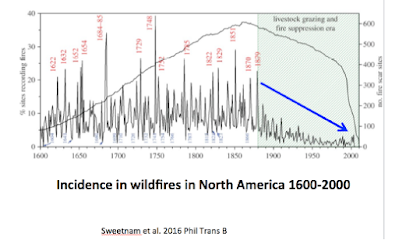
Rebuttal 1. Awareness of news does not mean it is a fact. Since we have access to news about everywhere and everything all the time it is easy to mis-perceive reality without objective measurements to put information into context and make it knowledge. The study below clearly shows a large decrease in North American wildfires since the industrial revolution. This is due to factors such as better land management, fire detection and suppression technologies, all powered by abundant affordable and scalable fossil fuel energy.

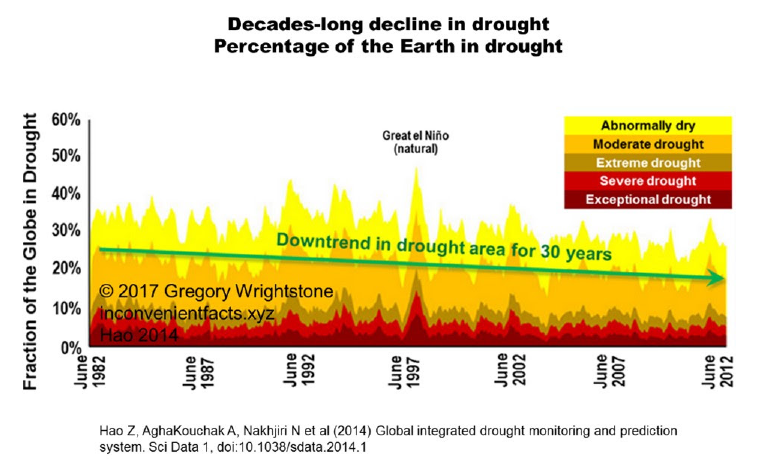
The same goes for drought, by the way, with a steady decline over recent decades due to technologies like irrigation, fertilizers, weather forecasting and the like.
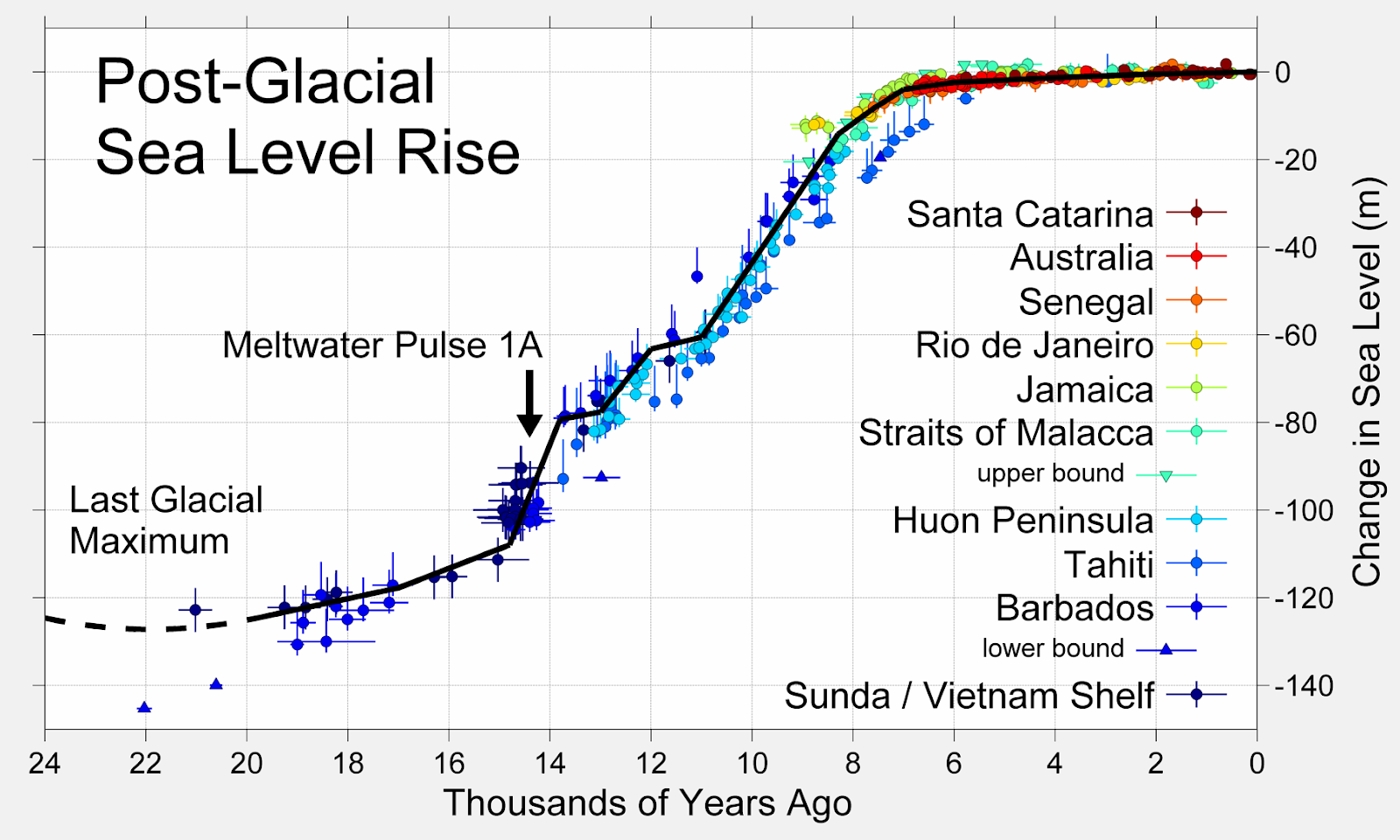
When it comes to floods, I presume the author refers to floods caused by sea level rise. In this case, like the others I will touch on, the full context includes looking at the historical record rather than models projecting doom. The graph that follows shows sea level over the last 24,000 years and highlights the effect of the end of the last glaciation that led to a sea level increase of 120 meters as most of the ice sheets covering land melted. The last few thousand years include a very gradual and steady rise, although this varies significantly depending on where the measurement is made. Tectonic plates move and collide steadily and some land masses are still rebounding from the mass of ice that pushed them down for millennia. Thanks to abundant machine energy humans can modify their shorelines and even raise buildings and cities if needed. With sea level changing slowly and steadily we have plenty of time to adapt to local changes. People in the Netherlands have managed to live below sea level for centuries and more people than ever before are choosing to build and live at the edge of the oceans.


Statement 2. The extinction of all living things is pretty well guaranteed unless our species starts acting now.

Rebuttal 2. There is literally no scientific data to support this statement and not even the biased IPCC science report makes any such assertion. In contrast, all measures of pollution and environmental damage decrease once a society reaches a sufficient level of wealth and this phenomenon is known as an Environmental Kuznets Curve. Seventy five years ago cities in the western world that were filled with air and water pollution are now far cleaner and safer and this occurs wherever freedom is allowed to grow and energy production flourishes.

Statement 3. Nature has always produced Co2 and methane, and it stored it through natural processes. This production and storage cycle was carefully balanced until we humans came along.

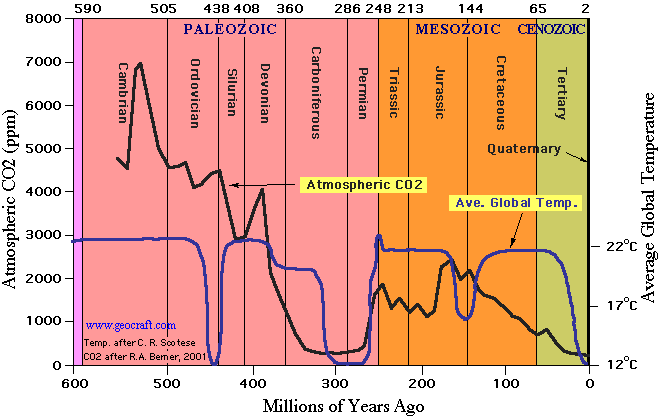
Rebuttal 3. This statement anthropomorphizes nature by using the word "carefully." Yes, there are many factors in balance in nature but nature, both living and inanimate is also constantly in change. Not only it is well established that the greenhouse effect of CO2 is a logarithmic one with further amounts having an ever-diminishing effect since a saturation point for the absorption of specific wavelengths is reached, the future effect of increasing Co2 is calculated to be about 0.5C. The graph that follows shows the geological history of Earth over the last 60 million years and CO2 has almost always been much, much higher than today and we can see that the correlation between CO2 and temperature is negligible. When CO2 is higher plant life flourishes and thus so does animal life. The graph shows the present CO2 level is close to a record low while there are periods of much higher CO2 and lower temperature. Over the shorter time scale of the last six hundred thousand years, Antarctic and Greenland ice core studies show that warming occurs first and CO2 level follows with an average lag of 600 years. 


Statement 4. News reports of wildfires, floods, hurricanes, droughts, melting ice fields, deaths by hyperthermia and killer pollution have become the new normal. 

Rebuttal 5. While it is true that news reports of natural disasters are the new normal, this is because we have so much more news, not because people are dying at a greater rate. In fact, it is just the opposite - and dramatically so. Deaths from extreme weather events have declined over the last hundred years - not by a factor of two or five, not even by a factor of ten, but by a factor of fifty - a 98% drop in deaths. This is due to our machine power that enables us to build resilient infrastructure, warm us of coming weather events, mobilize resources to support people at risk and rescue those in imminent danger. Deaths from cold are more than five times greater than those from heat, so a slight warming has saved lives. 

Statement 5. Once past the tipping point, global warming will keep on increasing beyond control. The eventual destruction of the Earth’s ecological systems will then eliminate the Earth’s supply of breathable air and potable water, and critically reduce habitable lands.

Rebuttal 5. There is no evidence for such a tipping point, it is pure and arbitrary speculation. Since CO2 in the atmosphere has been many times higher and no runaway warming occurred and since as pointed out above the potential impact of further CO2 is so small, this assertion is simply fear-mongering.

Statement 6. The August 2021 IPCC report stated, “Many changes due to past and future greenhouse gas emissions are irreversible for centuries to millennia, especially changes in the ocean, ice sheets and global sea level.” 

Rebuttal 6. There is no science to support this. This is a political statement and not a scientific one. For example, the graph below shows satellite data for the Antarctic since the start of the satellite era and it shows no change. Sea level was discussed above.


Statement 7. Can the human species become extinct? Why not? 

Rebuttal 7. The first question is a rhetorical statement since humanity's survival is not guaranteed by nature but rather is a constant struggle against a naturally dangerous environment. The second question is a matter of mastering machine energy, since with enough energy humanity can colonize the Moon, Mars and other planetary bodies and build starships that would enable us to leave our solar system. Heavier than air flight was invented just a short time ago (when my grandmother was born) and in just a few of my grandmother's lifespans we have advanced our knowledge and machine power more than in all of prior human history. Today a SpaceX ship is close to launch that is two thousand times cheaper to operate than NASA's best effort. 

Conclusion: for every assertion of danger or doom in the article it is easy to find hard evidence of the contrary or else the statement can be seen as lacking evidence - to be an arbitrary assertion. Since the statements are so consistently wrong, we must conclude there is a strong bias present in the writer's mind. If the statements were only partly wrong or were wrong in different directions then at least we could say there has been an honest effort to discover the truth. 

Energy is life. Energy is progress. Energy is the future of human flourishing. With energy mastery all is possible. In the name of all that is good about human life we need the freedom to explore all sources of energy, to experiment, to fail, discover new methods and applications. Today, fossil fuel energy powers 80% of all humanity's energy needs and those needs are growing fast, as is fossil fuel energy. Fossil fuels provide safe, dense, flexible, industrial scale energy that powers all other industries. Nuclear energy of some type is the most likely successor but has been criminalized by pressure from environmental advocacy groups since its discovery and is unsuitable in many applications. No other substitute for fossil fuels is know today.

All proposals to stop energy progress in the name of the weather, climate or pollution ignore all the fantastic advantages of energy capabilities. Such forecasts of doom are always based on hypotheses that have been proven false or upon models that have failed to predict real-world measurements. For humanity to flourish we require thinking that is firmly rooted in observations of reality, that are objective instead of subjective or arbitrary. 

Saturday, April 16, 2022

Regulators must not act now to forestall climate disaster

 The March 2022 edition of Canada's Investment Executive trade newspaper published an Editorial that was so badly done I had to comment. I sent them a letter to the editor but don't expect it will be published. Here is what I sent.

It is a disservice to the readership served by the Investment Executive that the editor promotes political IPCC climate alarmism rather than proven science on this subject. 

There are many sources if you want to learn about the state of scientific knowledge related to our climate, including the reports of the Non-Governmental International Panel On Climate Change (NIPCC), the annual “the State of the Climate” report, dozens of carefully researched books such as those by Bjorn Lomborg, Alex Epstein, Patrick Moore, Steve Koonin and of course thousands of articles from the peer-reviewed scientific literature demonstrating that the hypothesis for dangerous man-made global warming is false and the proposed political actions are destructive. The IPCC Summary For Policymakers is as far as many journalists go, and this document is not scientific but political. 

When it comes to climate-related risks, by far the greatest is that of government and regulatory interference. A perfect example of this is playing out these days with huge increases in energy prices caused by years of governments attacking the most abundant, cheap, dense, flexible and scalable energy known to man: fossil fuels. Now that the folly of relying on the Russian dictator for oil and gas is apparent and the insanity of relying on dictators in China for the minerals required for intermittent and unreliable energy sources like wind and solar is becoming apparent, economically and scientifically illiterate politicians who have threatened to “end fossil fuels,” promoted net-zero and pushed ESG are blaming high energy prices on the very businesses they have been trying to destroy. 

Human beings, left free to innovate and produce (especially in the energy field that powers all other industries) has easily and can continue to adapt even better to the historically modest changes recently seen in our climate. When coercion is used against producers and one-size-fits-all political rules are made, then risks become systemic instead of diversified. The editors of a newspaper giving voice to the investment sector should do proper due diligence instead of promoting ideas that are demonstrably false and causing great damage to human flourishing.

Tuesday, September 24, 2019

Greta Thunberg: Emotion In The Absence Of Reason

"Rising numbers of children are being treated for "eco-anxiety", experts have been quoted in the media, as they warn parents against “terrifying” their youngsters with talk of climate catastrophe. Amidst the furor about global warming one your girl has managed to become a media darling: Greta Thunberg. Greta has started and inspired millions of students to skip school as a proteest against government inaction on "climate change."  Many words have been used to describe Greta but a few of them have struck me as more prominent.

The first is the word "hypocrite."  On this I must agree. Thunberg and her ilk are attacking the very heart of modern civilization, using huge amounts of the very energy they so despise all along the way in order to destroy it. Her so-called "carbon-free" sailboat ride across the Atlantic, when the boat crew was flown back and forth by jet plane is only one of the most prominent examples. Much more profound is her ignorance of the incredible improvements in human life thanks to the energy from fossil fuels. The International Disaster Database shows that climate related deaths are 50 times lower than a hundred years ago. Not 50% but 50 times! Further, the decline is directly related to the rise of abundant, cheap and scalable fossil fuel energy that helps us build tougher structures move away from the naturally dangerous climate when needed, forecast dangerous climate events, transport safe water and food to affected areas and so much more. The human environment is vastly improved by fossil fuel energy. Greta's life on Earth is possible only because of such energy.

"Brave" is another word used to describe Thunberg. An uneducated child who has never held a job or produced a thing tells the world to revert to the pre-industrial age of starvation, deprivation, disease, racism and death - and many people applaud her for being brave. Actual bravery would be to stand for INDIVIDUAL RIGHTS in the face of soul-destroying collectivism; stand for REASON in a world embracing mysticism and irrationality as science and fact; stand for HUMAN FLOURISHING instead of calling for human sacrifices.


"Tragedy" is another good word. This uneducated gullible child has been persuaded to adopt an anti-human zealotry that will one day place her among the ridiculed in history books. She has no knowledge of the scientific process, no knowledge of the incredible improvement in billions of human lives thanks to the very energy she decries, no knowledge of the economies and personal life goals her ideas would destroy, no knowledge of the rights of the billions of individuals she would trample and seemingly no knowledge of the horrendous history of the type of political powers she embraces.

She embodies passion and emotion in the absence of reason, action without understanding, coercion without mercy, suffering and death without true cause, a mission of salvation absent rational justification. She represents what is wrong with modern education and politics. Greta must quickly be revealed as a fraud to avoid her insanity later in life when she realizes how very immoral and anti-life was the very foundation of everything she now stands for.


Greta is the puppet of a propaganda machine and should be criticized and corrected at every opportunity to avoid the suicidal future she urges us to adopt willingly.

Sunday, October 28, 2018

Modern farming? October 26th 2018 Ottawa Citizen page 2 article

Modern farming? I'd say it is more like milking the taxpayer and hydro ratepayers. Given that conventional reliable, safe, abundant and dense energy sources like hydro, nuclear, coal and natural gas can produce electricity for about 5 to 10 cents per kilowatt hour, paying the Heinzles 20 cents for biodigester electricity and 70 cents for solar photovoltaic electricity means other Ontarians are being forced to subsidize the lifestyle and income of the Heinzles and that lower income Ontarians, who pay the greatest fraction of their incomes for energy, are made to suffer the most to produce income for the "farmers".

While the article does not break down the more than $2M cost the Heinzles incurred to install solar and biodigester technologies, nor does it state their full income from solar, we can make a fair estimate from what is provided: $240,000 per year from biogas and $84,000 from solar. Given that the biogas is priced at up to four times and solar up to 14 times the cost of regular reliable forms of energy, if the Heinzles were paid a true market price they would be earning as little as $60,000 from biogas and $6,000 from solar per year. Thus, on a $2M investment they would be paid $66,000 which means a 3.3% rate of return on capital, before considering ongoing maintenance and operating costs - just over the rate of inflation. After operating costs the business would likely earn a return lower than inflation - a negative real return.

No rational investor would take such large risks for such a poor return and the fact that the Ontario Liberal government did just that shows how bad they were at managing Ontario's finances.

Wednesday, September 6, 2017

A Fossil Fuel Free Global Equity Fund? It's not right. It's not real.

In Canada, RBC funds has launched a mutual fund that uses an exclusion process to avoid companies involved in extracting, processing and transportation of fossil fuels.

They state this investment process leads to high conviction research driven portfolios and returns defined by stock-picking, not style, with a low correlation to peers.

I replied to the company's communication with the following message:

I think the concept behind the fund is incorrect, irrational, incoherent and immoral. The energy from fossil fuels has: 
a) powered the industrial revolution, 
b) advanced knowledge and society more in two hundred years than in all prior history, 
c) lifted billions of people from poverty, 
d) enabled the potential for a safe, healthy, long and productive life for all of humanity, 
e) eradicated almost all human deaths from the naturally dangerous climate, 
f) enabled us to wipe out the worst diseases of the past,
g) empowered women, minorities, former slaves and anyone with the mind and determination to do so to succeed beyond the wildest dreams of pre-industrial society,
h) much more.

To in any way promote the concept that fossil fuels, which presently provide 85% of all the power required to operate modern society, represent a meaningful threat to civilization instead of being the salvation of civilization is a monstrous distortion of reality and a disservice to all humanity. 

As a starting reference point, I have attached a fascinating article that studies the interaction between climate, human deaths and energy availability.

I note that every single holding in the fund relies utterly on fossil fuel energy to remain in existence. If fossil fuels were banned tomorrow, these companies would be instantly bankrupt and it would be the end of human civilization as we know it. With centuries of abundant, cheap, dense and portable fossil fuel energy available to us, not only is fossil fuel energy the fastest growing energy source in the world, but it is likely to remain by far the most important energy source for the next hundred years.

The company should be ashamed to be associated with the promotion of such a patently absurd concept as a fossil fuel free fund – it does not exist and should not exist.

Wednesday, May 10, 2017

MP McGuinty's October 4 2016 statement in the House is replete with fundamental errors

On October 4, 2016 MPP for Ottawa South David McGuinty made a statement in the House of Commons that was so full of economic and scientific errors I felt it worthy of comment. To find his statement follow the link and then search for his name and go to the second occurrence of it.

1. The statement says the issue of climate change has nothing to do with ideology, yet the very essence of the topic is political control over people's decisions regarding energy and how they live their lives. If advocating for a massive interference in the governance of the nations of the world and the use of political force against all of humanity is not an ideology then I wonder what an ideology is?

2. The statement refers to 2,200 Nobel Peace Prize winners. Aside from the fact the Nobel Peace Prize has nothing to do with science but rather is ideological, only the IPCC organization was awarded the prize, not 2,200 scientists. The scientists referenced are those whose work is cited in support of the IPCC hypothesis of dangerous man-made climate change warranting a massive restriction of human rights, a hypothesis which is explicitly rejected by many of the scientists whose work is cited by the IPCC.  Dr. Frederick Seitz, in reference to the 1995 IPCC report: "I have never before witnessed a more disturbing corruption of the peer review process than the events that led to this IPCC report." Richard Lindzen, prof of meteorology at MIT, who at first participated in the IPCC process but then gave up: "There's little doubt that the IPCC process has become politicized to the point of uselessness." "They controlled who participated and who were the lead authors, especially of critical chapters."

3. The statement refers to IPCC scientists as if the IPCC was a scientific body, when in fact it is a political body composed of government representatives. A small number of scientists write chapters for the IPCC reports and an even smaller number review the full content.

4. The statement states that we have droughts and floods. While no doubt true, this statement is meaningless since it ignores all context. Are such weather events similar to the past or not? Do they represent a greater or lesser danger to mankind due to our use of fossil fuel energy? There is massive evidence that humanity is safer from nature and nature is safer from humanity due to our use of fossil fuels. Global death rates from extreme weather events declined by 98 percent since the 1920s, while economic damages corrected for population growth and wealth have not increased. Similarly, the incidence of droughts and famines in history is well documented and has declined massively since the advent of fossil fuel energy.

And what about the IPCC itself? In the 2013 IPCC Technical Summary, under Key Uncertainties, there are a few interesting statements.


"There is only medium to low confidence in the rate of change of tropospheric warming and its vertical structure."

"Based on model results there is limited confidence in the predictability of yearly to decadal averages of temperature both for the global average and for some geographical regions. Multi-model results for precipitation indicate a generally low predictability. Short-term climate projection is also limited by the uncertainty in projections of natural forcing."

"In Antarctica, available data are inadequate to assess the status of change of many characteristics of sea ice (e.g., thickness and volume)."

"There is low confidence in an observed global-scale trend in drought or dryness (lack of rainfall), due to lack of direct observations, methodological uncertainties and choice and geographical inconsistencies in the trends."

"There is low confidence that any reported long-term (centennial) changes in tropical cyclone characteristics are robust, after accounting for past changes in observing capabilities."

5. The statement references the Stern report, which is an economic paper referenced to give support for the use of massive political power over citizens' activities. Economic analysis of the Stern report, however, shows that Stern chose to use an extremely low, near-zero discount rate (0.1%) instead of a normal rate such as 3.5%, thus essentially Stern equates cost and value today with that in the distant future, when we know that economic growth has made us many times wealthier today than a hundred years ago and that this trend continues. To highlight this, at 3.5% growth we would have 31.2 times more wealth in 100 years whereas at 0.1% growth we will be 1.1 times wealthier. This is not a trivial difference and reveals the uselessness of the Stern report.

6. The statement references the carrying capacity of the planet and the need to live within it. The notion of a planetary carrying capacity is an anti-concept that uses non-essential characteristics to make us think there is a problem. An essential characteristic of man is that he creates resources from raw materials found in nature. The raw materials have always been there and they only become resources through the application of human reasoning to make them valuable for human life. The concept of value is a moral one and not a scientific one, thus no scientist can identify a threshold for the excess creation of value, since there is no measurable limit to value creation. The entire physical matter of the planet is a potential resource for humans, as are other planets and stars.

The challenge of human food supply provides one illustration of the limitless ability of humans to create value. Before the discovery, commercialization and industrialization of fossil fuel energy, the basic condition of humans was to be hungry, weak and sick. With fossil fuel energy we live longer, healthier lives with abundant food. Only in the shrinking portion of the world that has yet to adopt a greater degree of capitalism and industrialization is widespread hunger a problem. 150 years ago, 25 men working all day harvested and threshed a ton of grain. Today with a combine harvester it takes… six minutes. Farm productivity is up 2,500-fold by this measure. In just the last 25 years 2 billion people have emerged out of a condition of hunger and only a single country's population gets less than 2,000 calories per day: Zambia. In just 25 years (1990-2015) extreme poverty was reduced by 138,000 people per day, for a total of 1.25 billion.

How does a reasoning being, faced with the incredible improvements in the human condition due to the use of fossil fuel energy that provides 85% of world energy not see the wonders we have accomplished? Only an ideology that sees humanity as a blight upon the face of the planet - a philosophy that is fundamentally anti-human - can oppose human freedom to produce more energy and progress naturally towards the discovery of even more abundant, more concentrated and even more powerful energy sources we will no doubt find. To quote Amory Lovins, one of the leaders of just such an ideology that has become known as environmentalism, "Complex technology of any sort is an assault on human dignity. It would be little short of disastrous for us to discover a source of clean, cheap, abundant energy, because of what we might do with it." Oh, the horrors of clean, cheap, abundant energy!


Friday, August 12, 2016

The economics of air and an anti-human ideology

I was engaged in an online discussion about climate change when another writer challenged my comments. When he asked "Perhaps you could start with why you believe you are not responsible to pay Market rent for fossil waste disposal by use of other people's air?" multiple times I thought a good response was in order and I have copied it below.
******************************************************
I get the strong impression that no matter how many highly intelligent, experienced, published and distinguished scientists from a range of fields identified factual contradictions and errors in your ideology it would not matter, so I will switch to the evidently hyper-important question that you have stated ad-nauseum above. It is evident you have no concept of the meaning of economics or freedom or capitalism, or else you would not ask such an irrational question. You might as well ask why you do not pay me for the use of the oxygen that you consume when you breathe. First, there is no such thing as a market rent for what you refer to. Second, what you refer to is not waste disposal but a natural by-product of human civilization and progress, a very mild side effect in exchange for an incalculable benefit, like an occasional headache in exchange for a cure for cancer. Third, other people do not own the air as it does not meet the criteria for private property. More broadly, it is the energy from fossil fuels that has enabled all of the advances of the industrial revolution, enabled your birth, being fed, clothed, housed, educated, your health care, your communications, your transportation and your leisure time. Until the discovery of a commercial means of mass producing energy from fossil fuels, you would have lived a short, diseased, starving, laboring, painful, cold and hot and extremely local life - if you lived at all. The energy from fossil fuels is the industry that underlies and enables all other industries and has been an incalculable good for humanity and has vastly improved your own life, yet you oppose it, perhaps even despise it like many catastrophists. To be fully consistent then, you would have to loathe yourself for owing so much to fossil fuel energy and the intelligent people who produce it. You appear to have an ideology based on looking only at potential harm in the distant future as predicted by computer models. This reduces to a base antagonism against human life and that which it depends upon. My philosophy is based on the irreplaceable value of human life and my standard of value is that which advances human life. I love fossil fuels, but not because they are fossil fuels, but for the wonders they have enabled humanity to achieve and continue to accomplish. As we speak, hundreds of millions of lives are being raised out of poverty and despair through fossil fuel energy. Fossil fuel energy has already solved the problem of world hunger, essentially eliminated the risk to human life from a naturally dangerous climate (deaths due to extreme climate conditions have decreased about 96% in the last 80 years, a period in which most of the fossil fuel in history has been used), enabled a vast division of labour and incredible specialization that has led to incredible wealth for the average person that was unimaginable to kings a hundred years ago. Yet this is what you are against and what you would have us give up - for what and in the name of what? For a life much shorter, poorer and filled with wretchedness where self-declared people who know better than we do dictate to us how we must live our lives. This in the name of the prophets of doom and their dis-proven computer models whose predictions are all over the map and have all over-predicted factual measurements - all in the same direction, because they contain the same false premises. Let the models and their true believers compete on an open betting market for accuracy and let the catastrophists place their bets on the accuracy of their predictions and let's see who loses all their money and who takes it all away. Now THAT would be a real type of market rent - a market for forecasting ability that rewards success and punishes irrationality. My money and the smart money is on the null hypothesis. I have no doubt that thanks to fossil fuels we will discover even better and more abundant sources of energy, but until then coal, gas and oil are the very best we have - and we are getting ever better at discovering sources of them, extracting them and converting them into usable energy that has lower and lower negative effects and greater and greater positive benefits. We now know of enough sources to last about a thousand years and we have just begun to discover how much energy is truly available to minds left free to search, discover, experiment and create. I believe that thanks to fossil fuel powered science we will soon have the use of essentially unlimited fusion power with a density a million times that of oil, that will replace almost all other sources of energy and will advance human progress as much as fossil fuels have already done. Until then, we owe it to ourselves, our lives, our children and those whose societies are still way behind ours to make the best use of fossil fuel energy we can and to continue to improve its use in every way possible.

Tuesday, July 19, 2016

Ottawa-Vanier climate consultation was a setup

Note: I posted this on the Ecology Ottawa site yesterday and today it has been removed after just a few hours.  I tried to re-post it but they seem to have blocked me. This time I edited a few remarks they may have considered inflammatory and wrote a preamble asking them to treat this as a reasoned, thoughtful argument and let readers make up their own minds by allowing them to read it.  We'll see if they allow it.
*************************************

The Federal Government wants to hear ideas from everyday Canadians about climate change. In many communities in Canada there are consultations going on that are supposed to enable us members of the public to have a voice in policy making.  I attended one of these in Vanier (Ottawa) in July 2016 and can tell you the entire event appeared to attract mostly people with a certain view, funnel them into discussion on topics that were pre-selected, have group notes taken by people whose minds are made up and have full-group statements made only by those same note takers with no opportunity given for individuals to address the full audience or speak up to the municipal politicians in attendance.

The event was hosted by Ecology Ottawa, whose website report on the event can be read here.  On the way into the event the reception table had literature about stopping energy pipelines such as the proposed Energy East, which would allow the product of Alberta and Saskatchewan to be shipped to refineries in eastern Canada with less wasted energy and much more safely than by using trucks and rail. This immediately made it obvious the town hall was not to be a full and reasoned discussion but a directed lobbying effort with foregone conclusions.

At the start of the session there was no initial presentation of facts upon which the discussion was supposed to be based. Rather, there were pre-written questions written on cards that were placed on tables - questions that presume to summarize a vast scientific data set that in fact remains under great debate and dispute, never mind the extrapolated implications that can be dis-proven with a little knowledge of economics. It was perfectly clear to me that the presumptions of the evening included the idea chain known as dangerous anthropogenic global warming (DAGW), namely that:

  1. the planetary mean temperature is rising
  2. this rise is outside the historical range
  3. the rise is caused by atmospheric carbon dioxide (CO2)
  4. human activities are causing the rise of CO2
  5. the rise of CO2 and temperature represent a significant danger to human life
  6. human industrial society cannot easily adapt to the temperature change
  7. drastic measures to reduce then eliminate the use of energy sources that produce CO2 are warranted
  8. governments are morally correct to initiate force against energy producers and consumers (everyone) to coerce them into taking these drastic measures.
In a chain of reasoning if one link is erroneous then the conclusion cannot be supported. When I first began to study these issues in the early 2000s I accepted some of these assumptions as true but I quickly learned there was a great deal of contradictory evidence and that much of the information supporting DAGW was exaggerated, misleading or even falsified. I found that except for item 4 in the chain above, everything else in the list was either patently wrong or at least there was serious concern about its validity and/or significance.  Eventually I realized that the whole concept of DAGW was so fundamentally flawed that it could be safely rejected as irrational but that it would likely take humanity many years to purge the errors from the realm of public discussion. As the weight of scientific evidence de-bunking DAGW continues to grow, its advocates are doubling down on their rhetoric and lobbying effort to gain political power before the scheme is exposed as delusional.

Now back to the town hall event. As I said, the discussion questions were pre-selected and presumed all of the eight statements above are true. Participants were asked to discuss topics such as innovation to reduce CO2 production, ways to reduce CO2 production in daily life and the like. I chose to sit at a table where innovation was the main topic.  Realizing the group leader (an Ecology Ottawa representative) and the group itself would likely stop listening and become hostile to further ideas if I voiced my direct opposition to their DAGW assumptions, I chose to actively listen and to try and inject an element of rationality into the discussion. For example, when others advocated for massive use of government force against citizens in the areas of housing and transportation I suggested that all proposed measures should be tested against a vital standard - the harm they might do to our most vulnerable citizens if the measures were enforced, absent such distorting side-measures such as subsidies and wealth confiscation and redistribution, which mask the true and intended policy effects. If a policy makes energy more expensive and thus makes life harder for citizens, the damage to their lives must be considered, not to mention the more important moral propriety of causing them harm in the first place. Taking one person's wealth and giving it to the damaged person does not solve the problem, it only expands the scope of damage.

I tried to get our group talking about energy innovation and to show that while fossil fuel energy is currently the best source of dense, abundant, safe, cheap and portable energy, that it was not likely to remain so as nuclear fission energy could be unshackled and replace much fossil fuel energy with far less CO2 production, never mind the exciting potential of nuclear fusion in the near future that has unlimited potential to produce safe, distributed, cheap and abundant energy to all of humanity, improving human life by an enormous measure without CO2 emissions. To my dismay but not my surprise, one group member spoke strongly against fusion energy by saying that abundant cheap energy would release heat and cause the planet to warm dangerously.  He apparently has no idea that the amount of heat itself is not a dangerous issue and that the Earth's climate system has a number of auto-regulatory mechanisms that prevent large changes in temperature, absent external changes in energy from the Sun. The fact that he saw what could be the greatest source of energy ever discovered, that could advance the quality of human life beyond measure and lift entire civilizations out of poverty, starvation and disease if allowed to progress as to be avoided at all costs was a scary testament to the philosophy of those who believe in DAGW. Maybe he thinks solar panels and windmills do not produce heat as a by product or that society should stop progressing or even regress to pre-industrial times.

At another point I tried to help the group see that cooperation (persuasion by means of reason, a part of the political-economic system known as capitalism) was the proper and moral path to energy policy and that coercion (use of force to override the free will of individuals) was to be avoided as improper for a free, human, reasoning society. While there were a couple of faces that appeared sympathetic to the idea, I sensed a lack of understanding of what political force really means and a young man beside me stated clearly that while persuasion and cooperation are good, that at a certain point force must be used.  In this context I did not dare to point out to him and the group that his was the political ideology of Lenin, Mao, Stalin, Pot, Chavez, Castro and many others whose policies led to the death and suffering of hundreds of millions of human beings. I did not point out that his idea was contrary to the discovery of political freedom in the enlightenment, the advance of humanity in the consequent industrial revolution and the founding principles of the country he lives in. Such statements would have certainly provoked strong emotions and blocked any modest, reasonable ideas I was trying to get on the table.

I must give credit to our group leader dutifully and quite fairly recorded comments and did not override the discussion. During the summary session he actually mentioned my idea of having a "harm test" for every policy initiative. However, the entire event was structured so that no participant had any opportunity to speak to the whole group since only Ecology Ottawa group leaders were given the floor, and they generally spoke from the very same perspective, having likely had only participants from that same perspective.  I think most people like me, who have opposing views based on considered research and reasoning, would not consider attending an event positioned like this as they would see it as a waste of time and they would not be listened to.  That was my expectation yet I chose to use the event as an opportunity to look inside the minds of those who have opinions different from my own, to see if I could learn more about them, how they came to hold these ideas, how well reasoned they are and if they are open to discussion. 

I am sad to say my impression is that they are not at all open on this subject. When have you heard of a public debate on the science of climate change? When has such an event been held by your political representatives to help them understand the related issues? Why do people like Al Gore steadfastly refuse to engage in a public debate? Why are people with differing opinions being prosecuted for holding these ideas? Why does David Suzuki advocate for jailing people who produce life-promoting fossil fuel energy and those who advocate for its continued use? Why do so many people ignore the basic science done by hundreds of researchers all over the world that contradicts and even disproves all aspects of the DAGW hypothesis chain of ideas and instead continue to advocate for massive political force against innocent citizens?  These questions and many more will need to be answered and understood if humanity and our life-promoting industrial civilization is to survive long into the future. Such crucial topics will very likely not be discussed at climate change town halls across Canada.

Monday, June 6, 2016

Comments on "Our car runs on the sun"

The June-July 2016 Image article “Our car runs on the sun” not only contained a number of explicit and implicit fallacies, but more importantly it omits the economic and moral aspect of government solar panel and electric car subsidies. Let me explain.

First, the economic side of the issue.  Having personally installed, maintained and used solar panels at my off-grid cottage for more than 20 years, I am very familiar with the technology. It galls me when people speak glowingly of their solar panel installations and completely miss the deliberate negative consequences when government interferes in the market for energy. Basic economics indicates we have abundant, safe, dense and portable fossil fuel supplies to last us centuries, long before which we will certainly have found even better energy sources, with nuclear fusion a most likely candidate I think (and hope). While photovoltaic panels are coming down in price and getting better, they are nowhere near viable as sources of reliable industrial scale energy, costing several times as much as existing energy sources and suffering from being intermittent, unreliable and low in power density.

To build solar panels requires intensive mining for rare earth minerals, often done in third world countries that are less wealthy and so do not take such great care in the handling of toxic by-products and in site restoration. To build electric cars and their huge batteries again requires large amounts of mining for minerals, not to mention all the other industries required to build the car. Then there is the fact that every panel connected to the grid decreases grid reliability and efficiency since, in contrast to existing sources, solar panels spit out power in an unpredictable fashion, forcing reliable power plants to ramp their use of coal, gas, nuclear and hydro up and down to balance the grid second to second. Thus, reliable industrial power sources are made less efficient because of the constant adjusting for solar power. For every kilowatt of solar panel connected, the grid requires 100% backup by a reliable energy source for the majority of the time when the sun doesn’t shine, thus making the whole system more expensive for everyone, harming most those who can least afford deliberately jacked-up prices. When the people harmed most complain, government gives them subsidies too, so they are first being punished and then rewarded for the same thing, both actions being outside the proper role of government.

Now to the moral problem. If solar panels and electric cars were in reality such wonderful products, people would flock to buy them and create a large and viable market for them. Exactly the opposite has happened. Unless government uses money forcibly taken from taxpayers to heavily subsidize panels and cars, almost no one buys them of their own free will and based on their rational judgement. The writer of the article is being paid about ten times the price at which energy can be produced, absent government interference. In truth, he is being paid on the backs of the people who cannot afford to put $20,000 panels on their roof and buy $40,000 cars. This is pure “weathfare” - the more wealthy being subsidized on the backs of the less wealthy, and is immoral since it is a case of government violating the rights of some citizens to benefit others. Ontario’s Auditor General has highlighted how Ontarians have paid tens of billions more for power in recent years than they would have if not for government interference. This has caused great harm to all Ontarians and is blatantly anti-freedom.

While it is tempting to read the simple story of one family and think it is a nice, encouraging story of how to make Ontario better, while it is actually a cautionary tale of the economic destruction, rights violations, inadvertent consequences and immoral outcomes that have to occur when government force interferes in the free decisions of citizens.

Thursday, September 24, 2015

Are we all socialists in practice?

The following was a comment made in response to a post I wrote about Donald Trump and Bernie Sanders.

Commenter 1: We're all socialists in practice--that's a good thing.
Socialism: A political and economic theory of social organization that advocates that the means of production, distribution and exchange should be owned or regulated by the community as a whole.

In other words:
Social Security
Medicare
Medicaid
Libraries
Museums
Parks
Fire Stations
Garbage Collection
Local, state and national agencies that ensure the public welfare
Cooperatives
Public Utilities and Infrastructure
Public Schools
Public Hospitals
Public Transportation and Roads
Public Airwaves
Public Housing
Agriculture Support (farm subsidies)
Veterans Administration
National Institutes of Health
Environmental Protection Agency
Law Enforcement
Military
-----------------------------------
Naturally, I could not let that stand unchallenged.
My reply: You have equated the existence of many things with the necessity that they be done through coercive action of government. Libraries, museums, parks, fire stations, garbage collection, cooperatives, utilities, infrastructure, schools, hospitals, transportation, media, housing, agriculture and law are properly (morally) the product of people working to improve their lives through creating values and voluntarily exchanging them with others. It is only cooperation in a free society that enables each individual to pursue his own happiness and results in a truly peaceful coexistence. All of the things I mention existed before government monopolies and would continue to exist but be better and more abundant in a society where the protection of individual rights was the basis for government.

You mention cooperatives, as if a the government of a free country would act to prevent cooperation of any kind, when in fact cooperation is the only type of economic exchange permitted under capitalism and coercion is banned.

You mention housing, yet the provision of low cost housing is prohibited or at least severely discouraged by the maze of development, zoning, construction, labor and tax rules that make housing less plentiful and more expensive than it would be in a free market, especially for the poorest.

You mention farm subsidies, as if taking money from people who have produced wealth and giving it to those who have not earned it is a proper role of government. This serves to support high cost providers, prevent innovation and competition and make it more expensive for everyone to buy food, damaging the poor the most. Then, when housing and food are made more expensive by government interventions, there is a call for more subsidies to help the poor, causing a further inefficiency, more unintended consequences, higher prices, and so the damage rolls on.

Interestingly, the only proper roles of government are at the very bottom of your list - the roles that an objective government is required to perform to protect the rights of the citizens who have delegated the very specific power of the retaliatory use of force. A government must protect citizens from criminals through the police, protect a country from outside aggression by the military and provide courts to arbitrate disagreements between citizens.

When government instead acts to override the decisions of citizens who are not violating rights, it becomes the worst aggressor - one with the power of force against which, once government has abandoned its role as protector, there is little recourse. For example, consider energy utilities. Private, individual citizens created the industry from nothing. Industrialists brought these ideas to the mass market , brought prices down t affordable levels and built stations, networks, maintenance services, etc. Governments looked at this and saw how important this wealth was, how much value had been created and then seized control of much of the industry. The parts they did not take, they regulated. Now the utilities are in many cases monopolies, facing no competition, bloated by bureaucracy, filled with entrenched unions, lacking innovation and plagued by service complaints. I use the Hydro utility in Ontario as my prime example of this.

Yet, there is not a single aspect of running a hydro utility that can be done more efficiently by a government agency than a free market. Consumers have lost the ability to choose, lost the crucial economic signals provided by a free market, lost the price mechanism that so effectively drives capital investments and service focus, lost the innovations that inevitably come from competition and the quest for efficiencies. Creative and productive individuals who would go into the business if they were allowed to build and own their own businesses are forbidden by the monopoly. The hiring of executives is done more by nepotism and political pull than by merit and ability. In short, a service that is properly run by freely acting citizens that is instead run by government force results in the destruction of human potential and reduces our quality of life. And we never get to see the advances that are blocked, the innovations prevented, the progress made that is stifled. How much better off would Ontario be if we had freedom in energy production instead of a stale and stagnant monopoly? We may never know. I recommend reading 'Economics in One Lesson" by Henry Hazlitt - about 70 years old but still spot on.

Thursday, September 17, 2015

Discussion of article - Deniers Are All Over the Map

Following a recent article by David Suzuki, I wrote some comments on the website that attracted some fairly strong opposition and I think the discussion is worth recording here. As the threads get deeper it is harder for me to reproduce is sequence while cutting out the off-topic comments.
---------------------------------------------------------
My original comment:
I guess Suzuki would call me a denier but I am just a guy with a pretty good reasoning mind who looked harder at the research findings over a decade ago. I started out accepting what guys like Suzuki were saying because it sounded plausible and I had not studied the questions myself. Once I did, I found a significant and growing body of evidence from a range of disciplines that not only cast doubt on the global warming scare, but revealed massive violations of the scientific method among the global warming crowd. In short, the movement had been politically motivated from the 1980's and has become hysterical now. The more their ideas are proven wrong, the more cover ups are revealed, the louder they yell and the more they insist on implementing massive political controls over our activities. For goodness sake the IPCC keeps contorting its models and statements to fit the measurements instead of producing accurate predictions using models and consistently fail to acknowledge their models have failed, despite solid evidence over the last nearly thirty years. Their models have been so far from reality that any rational and attentive person would dismiss them out of hand. Don't take my word for it, just read the work of many of the world's top researchers in climate, statistical modeling, paleo-climatology, astrophysics, geology, atmospheric physics and even good old history. Make up your own mind and don't accept anyone's wild statements of catastrophe as truth - such claims have always been proven baseless in the past.

Critic 1Go Team McGruer!
In summary DMcG = master of logic and nice guy.
Thousands of climate scientists working for decades = incompetents / liars/ political shills engaged in a decades long global fraud involving every scientist from the oldest to they youngest working independently across the world, speaking in different languages and rooted in widely divergent cultures, with no shift in the core advice regardless of shift back and forward in Government from Democrat to Republican and back in the US, from Labour to Conservative in the UK......... always the same message!
Reality = whatever DMcG says it is regardless of .....er reality.
His post is not wholly without merit: when he suggests that you 'don't take his word for it,' you might want to look at information from organizations such as NASA. The following is a really clear summary:
As for DMcG, I suspect that he knows that he is 'just a guy with a pretty good reasoning mind' because he sat down and worked it out himself but didn't check the findings with anyone else.

Critic 2"I am just a guy with a pretty good reasoning mind."
Comment under Tom Harris ICSC video:
Dave McGruer 2 years ago
Good work Tom. I especially like your comments about the moral meaning of opposing fossil fuel use. Since human life depends on our ability to reshape the environment, opposing such actions is clearly anti-life. Modern environmentalism is out to return man to the stone age.
Ontario Votes 2007: Interview with Freedom Party candidate David McGruer
"The taxation of property if a direct violation of rights and should be abolished as quickly as possible."

My response to critic 2: I am proud of every word in those statements. It is human nature to shape our environment to improve our lives. We are not lower animals surviving by instinct. Today's environmental movement is anti-human. Many of the movement's leaders have been clearly quoted to that effect, perhaps the worst being that "the best thing that could happen for the Earth is a plague that wiped out most of humanity" (approximate quote). If you are a defender of that statement, you are definitely anti-human. I am pro-human. As to taxation of property, the use of force against innocent citizens is not proper in a free society. If I buy a property then I should own it - this is the very nature of a property right. It is not moral or proper for an organized group to take my money under threat of seizure or imprisonment if I fail to pay their arbitrary demands. In a free society all transactions are voluntary and for mutual benefit and not done under coercion. Do you assert otherwise?

Critic 1: What environmentalists think or do is besides the point.
This is a scientific issue, based on a scientific case that has developed over nearly 200 years with a rapid acceleration of our understanding occurring in the last 30 years. We are now at a point where 100% of national and international level academies of science accept the reality of AGW, frankly in the face of that level of agreement what Greenpeace do or don't think is irrelevant.
You might plead your pro-human position, but if you ignore the scientific advice then you are closing your eyes to a central consideration in the preservation of human well-being in favor of short term profit.

Critic 2Of course property is more important than life itself. Who could disagree with that?
Approximate quote? LOL.

My response to critics 1 and 2: I did not say property is more important than life. Property rights are a corollary and necessary extension of the right to life. If you do not have the right to property then you are working without owning the product of your work - you are a slave.
More quotes from environmentalist luminaries:
Patrick Watson, Greenpeace co-founder: "It doesn't matter what is true, it only matters what people believe is true."
John Holdren, advisor to President Obama for Science and Technology, in his 1977 book (paraphrased for brevity): Women could be forced to abort their pregnancies, whether they wanted to or not. The population at large could be sterilized by infertility drugs in drinking water or food. Single mothers and teen mothers should have have their babies taken away from them and given to others. A transnational 'Planetary Regime' should assume control of the global economy using an armed police force.
Prince Philip: "In the event that I am reincarnated, I would like to return as a deadly virus, in order to contribute something to solve overpopulation... We need to cull the surplus population."
Ingrid Newkirk of PETA: "Mankind is a cancer; we're the biggest blight on the face of the earth." "Phasing out the human race will solve every problem on earth, social and environmental."
Maurice Strong, architect of the IPCC ideology: "Isn't the only hope for the planet that the industrialized nations collapse? Isn't it our responsibility to bring that about?"
Director of the CRU, Phil Jones, on the subject of scientific papers he does not want to see referenced by the IPCC: "I can't see either of these papers being in the next IPCC report. Kevin [Trenberth, see quote from him in earlier post above] and I will keep them out somehow - even if we have to redefine what the peer-reviewed literature is."
Stephen Schneider, prominent IPCC member: "Scientists need to get some broader-based support, to capture the public's imagination... that of course. entails getting loads of media coverage. So we have to offer up scary scenarios, make simplified dramatic statements, and make little mention of any doubts we may have...each of us has to decide what the right balance is between being effective and being honest."

Critic 3: David, the fact that greenhouse gasses warm planets has been the undefeated scientific understanding for over a century.
Do greenhouse gasses warm planets?
"The heat-trapping nature of carbon dioxide and other gases was demonstrated in the mid-19th century"

My response to critic 3: I am absolutely not saying there is no greenhouse effect. I am saying that the dominant greenhouse gas is water vapour, which plays a crucial role in the autoregulatory mechanism of the Earth's temperature. When CO2 rises, water decreases slightly and so the net effect is minimal. This idea from the research of an atmospheric physicist.
I am saying that the science shows clearly that global warming has caused CO2 to rise for hundreds of thousands of years, not the converse.
I am saying that the greenhouse effect of CO2 diminishes as its concentration rises.
I am saying that satellite measurements for 30 years proves the alarmists theory of the troposphere warming mechanism is false, that the IPCC models are false (they keep adjusting them to back-fit).
I am saying that humanity can adapt to slight changes in temperature and has done so for a long time, even before the industrial revolution unleashed the unlimited potential of the human mind to improve our lives.
I am saying that if e are left free of the political and intellectual shackles the alarmists wish to use to throw us backwards in progress, then we will solve all the challenges posed by climate change, whether natural or human influenced.
I am saying that over history, natural cycles of climate change dwarf the tiny effect humanity has had on the climate.
I am not denying that the climate changes, I can name many sources of such change and discuss it over decades, centuries, millienia or millions or billions of years. Change is a constant in our climate, it has never been stable and never will, unless it becomes stable to to tremendous advances in technology many years ahead.

Critic 1: This is from New Scientist:
"A simplified summary is that about 50% of the greenhouse effect is due to water vapour, 25% due to clouds, 20% to CO2, with other gases accounting for the remainder."
The article goes on to say that the problem is longevity. Water vapor has a rapid atmospheric turnover typically days while CO2 can persist for anything from 100 to 800 years in the atmosphere. In basic terms, over time the CO2 levels will continue to increase.
However, as I am not a scientist, I hesitate to make definitive statements so here is the link to source.

Critic 2: Why is it so hard for people simply to understand that however great the greenhouse influence of water vapor is, we have no direct control over it. Because warm air simply holds more water vapor, water vapor will act as a feedback and amplify whatever else we do, but we can't control atmospheric water vapor directly. If we want to control water vapor, all we can do is focus on those factors that we do have control of -- which essentially means approaching the global warming problem the same way we would if water vapor was not an issue at all. Mainly it means focusing on CO2 emission levels from the burning of fossil fuels. (To bring down water vapor.)

My response: But that is precisely the point - we cannot control it. A major error of alarmists is they reverse the impact of clouds, thinking water vapour magnifies CO2 effects, when high clouds actually cause the planet to cool. This alone invalidates the entire IPCC models structure. Measurements show that as CO2 has increases, water vapour has decreased exactly enough to offset the greenhouse effect, thus no significant change takes place unless there is a change in the energy input into the system or a change in the cloud albedo level.
On a tangent here, a reader should be able to tell by now that there are large areas of climate science that are not yet certain and we are learning more all the time. The cloud effect and its causes, the land use change effect, the question of climate equilibrium, the various solar and planetary orbit cycles, the cosmic ray effect, discoveries in paleo-climatology, and the list goes on. For anyone to claim definitively that a single simple variable like CO2, present in minute, trace amounts in the atmosphere is responsible for dangerous, man-made change that we will not be able to correct or adapt to is to ignore all the principles of reason and science.

Supporter: Good points, Dave. Climate activists are convinced the ends justifies the means, no matter how unethical the means actually are.

My responseThank you Tom. As you know, I believe the ethics of this subject are vastly distorted by the alarmists. I believe their underlying philosophy is anti-human. Otherwise, they would celebrate the vast reduction in climate deaths over the last 80 years and the rapid advance in quality and longevity of humans too, all powered by advances in fossil fuel energy.

Critic 2: What makes you think any of us are arguing that that fossil fuel technologies haven't brought any great advances? But that is an entirely different question than the one that is now front and centre, which is whether in the course of enjoying all this good fortune that oil and fossil fuels have bestowed upon us, we have overlooked a by-product of their use, belatedly found to be the destruction of our climate. Unless we take care!

My response: What makes me think it is the fact that many intellectual leaders of the environmentalist movement state clearly that they consider what I call advances to be regressive and wish to see humanity revert to the pre-industrial age. Further, since the advances made actually allow us to better deal with ANY potential problems, regardless of their cause, we are better off continuing to use the most economical source of energy. As we advance, we pollute less, get more efficient and discover new energy sources, so let's keep going on this path, which is the best one mankind has ever seen. More, since the climate is patently not being destroyed, but only slightly modified, measured in fractions of a percent, there is not even a danger on the horizon. See my other comments about the equilibrium mathematical discoveries of Miskolczi elsewhere.

Another thing is that the type of care you espouse, known as the precautionary principle, actually paralyzes man and blocks all advance. It states that if an action might cause some type of negative effect some day then you should not proceed. What is missing from this is the positive side, which is often ignored. For example, energy from fossil fuel has been the foundation of the industrial revolution, which has led in a brief couple of centuries to the greatest improvement in human life in all history - and this is despite the modest negative effects, which are normally larger at the early stage and then men learn how to reduce them as they progress.

For example, a hundred years ago men burned coal to heat their houses, causing terrific indoor and outdoor pollution, yet human life advanced at a great pace. With further advances came cleaner use of coal, then oil, then natural gas, each stage getting more efficient, cleaner, safer and more abundant. When men have sufficient wealth to be concerned about a problem then they will address it, if they are free (not prevented by government power) to do so.
To illustrate this, consider that natural gas is cleaner than coal or oil, yet environmentalists attempt to block every pipeline, every trainload, every new well, every new extraction technology that scientists and businessmen come up with. They attempt to block advance and then lobby for a reversal of existing progress, or else they want to take some type of impossible leap forward, mystically bypassing all the incremental advances needed for real progress, straight into some nirvana of pollution-free energy. Then even when a new energy source is proposed or discovered, they even oppose that! This pattern is a clear illustration of their anti-human ideology.

Critic 2: How do you measure fractions of a percent of a climate? Our industrial age has propelled atmospheric CO2 from 280 to 400 ppm, a 28% increase, the consequences of which you can't ignore if you want to make a balanced assessment of the fossil fuel age.

My response: 400ppm is 400 millionths or 0.000004%. That is what I mean by fractions of a percent. Clear?


My second comment: I find the research of Ferenc Miskolczi regarding the saturated equilibrium equation for atmospheric energy exchange with space to be fascinating. I just re-read one of his 2010 published research articles and a 2009 paper summarizing his work up to that date. Miskolczi was the first to calculate the precise global mean infrared optical depth of the Earth’s atmosphere — the exact radiative-transfer measure of the greenhouse effect. What he found was that the Earth’s atmosphere maintains a constant effective greenhouse-gas content and a constant, maximized, “saturated” greenhouse effect that cannot be increased further by CO2 emissions (or by any other emissions, for that matter). After calculating on the basis of the entire available annual global mean vertical profile of the NOAA/NCAR atmospheric reanalysis database, Miskolczi has found that the average greenhouse effect of the past 61 years (from 1948, the beginning of the archive, to 2008) is:
a) constant, not increasing;
b) equal to the unperturbed theoretical equilibrium value; and
c) equal (within 0.1 C°) to the global average value, drawn from the independent TIGR radiosonde archive.
During the 61-year period, in correspondence with the rise in CO2 concentration, the global
average absolute humidity diminished about 1 per cent. This decrease in absolute humidity
has exactly countered all of the warming effect that our CO2 emissions have had since 1948.
Similar computer simulations show that a hypothetical doubling of the carbon dioxide
concentration in the air would cause a 3% decrease in the absolute humidity, keeping the
total effective atmospheric greenhouse gas content constant, so that the greenhouse effect
would merely continue to fluctuate around its equilibrium value. Therefore, a doubling of
CO2 concentration would cause no net “global warming” at all.
Surface warming is possible only if the available energy increases. This may happen through changes in the activity of the Sun, or through variations of our planet’s orbital parameters, or through long-term fluctuations in the exchange of heat between the ocean and the atmosphere.
There are also some man-made sources. Air-pollution by aerosols (soot, black carbon, dust, smog etc.), and large-scale surface modifications according to urbanization and land-use change may—and probably do—alter the amount of absorbed and reflected shortwave
energy, and can hence lead to change in the long-term energy balance.
I note that Miskolczi's work appears entirely consistent with the work done in the fields of geology, paleo-climatology, astrophysics and cloud formation, that find a close link between cycles of the Sun and cosmic ray penetration of the atmosphere causing cycles of cloud coverage, which of course affect the net energy reaching the Earth. Logical and validated by cross-disciplinary research showing very strong strong correlations over all major time scales.

Critic 2: Ferenc Miskolczi

My response: Okay, so I read the link and it appears that when Miskolczi reported new findings that appeared to contradict the orthodoxy of global warming he was ostracized along with a fellow author. No surprise there. The great discoverers of history have mostly been opposed vehemently by the established interests such as the Catholic Church, or even the Church of David Suzuki.